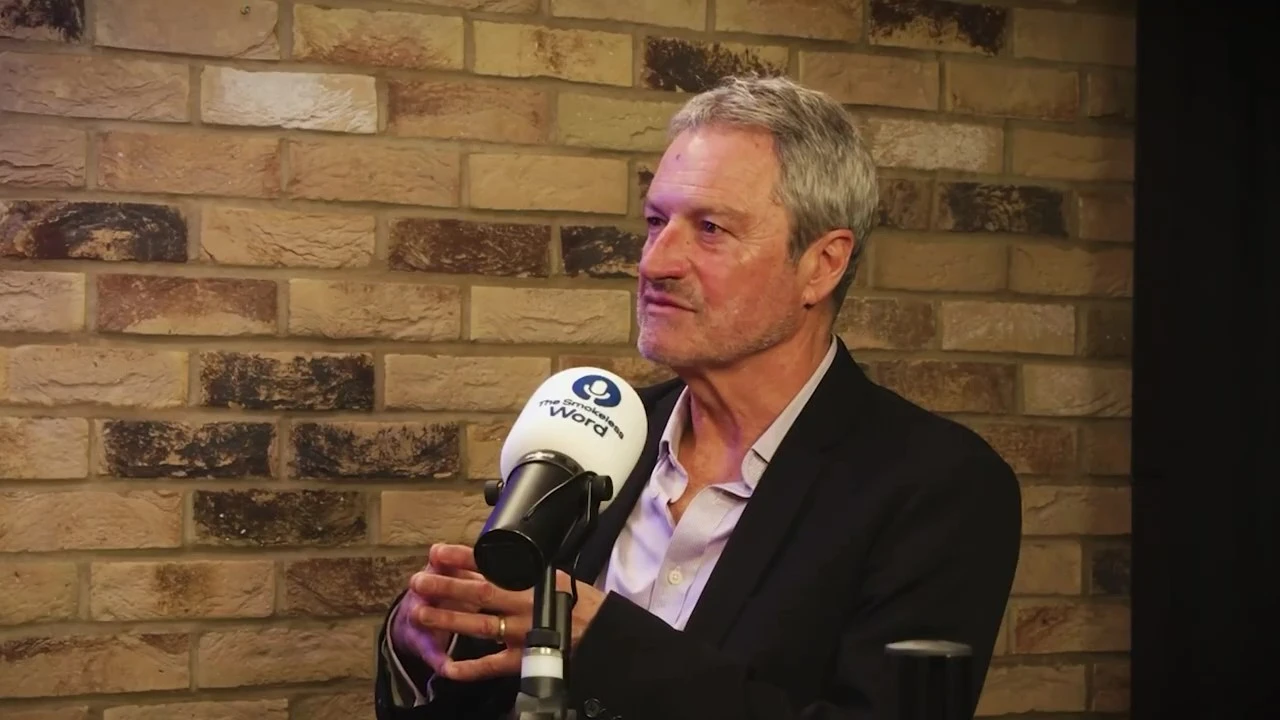

Episode 12: Gavin Esler

Gavin Esler
Lying has become a strategy.
Kingsley Wheaton
Where would you get the truth? How
Gavin Esler
interesting? Because we're all time poor. We don't really have time to deconstruct exactly what politicians are saying. The deluge of information means people are turning off in democracies. That's why there is a democratic deficit right right around the world, 40% of British people who could vote don't bother to vote, and they're sometimes called apathetic. Some are apathetic, but I think a lot of us are just a bit angry. Most of us who live in the United Kingdom think in many ways, this is a great country. But why are we underperforming? We're not stupid. So why do we keep doing stupid things.
Kingsley Wheaton
Welcome to the latest episode of the smokeless word. Today, I'm really excited to be joined by Gavin Esler, former Newsnight presenter, celebrated BBC journalist and author of 10 books, Gavin and I will talk about his journey from reporter in Northern Ireland to an award winning broadcaster and podcaster, and about how leaders communicate the challenge of disinformation and the need for a pragmatic approach to tobacco harm reduction. I hope you enjoy this episode. This podcast is intended for regulators, scientists, policymakers and investors. Only the views expressed in this podcast are the personal opinions of the speaker. Only any references to products having a reduced risk or reduced harm are based on the weight of evidence and assume no continued smoking. This material is not intended for us audiences. Gavin, welcome to the smokeless word studio. What do you think? How is it to be here?
Gavin Esler
Well, it's the glamor of it's the glamor that I came for. No, it's great. It's very, very nice to be here. I'm slightly surprised to be here.
Kingsley Wheaton
Why is that? Why? Why are you surprised? Well, because
Gavin Esler
you know that I have never smoked a cigarette in my life. I've never had a I've never had a lit cigarette in my life, in my mouth, in my life. And you know, when I was about 10, my father got very who'd been in the army. He smoked a lot, got very sick, had a lung problem, and quit smoking like that. And so nobody ever smoked after that. He was man of considerable iron will, and I respected it, and I just never even thought of smoking so but I am interested in what is changing in some of the biggest companies in the world, including yours, and what can be done about making perhaps people who smoke healthier by doing something else. Because, you know, prohibition was tried before with alcohol, and it was a total disaster. It led it was good for the mafia, but for everybody else, it wasn't very good. So what can be done? And I've been looking at some of the science, and I'll be corrected on it, on some of it, but it is very interesting, good.
Kingsley Wheaton
Well, I'm delighted you're here. We'll talk far more about we'll see that's the whole purpose of this, just before we get on to some of you know, before we talk about you and your career. And then we'll sort of segue in. One of the more interesting things that I found when I was researching was that you were a quarter finalist on MasterChef. How did that go? How did it happen? How did it come about?
Gavin Esler
Well, I was robbed. Obviously, I love cooking. I love cooking, and I was asked to go on and unlike Strictly Come Dancing, when I was asked to go on that, I won't tell you exactly what my wife said, but broadly, it was a no. I master chef was a yes, because I, I cook at home. I have but one, well, I've got many, many weaknesses. But one is, I don't even eat puddings. So the idea of cooking a dessert or a sweet was rather difficult because I don't I don't like them, I don't like sweet stuff, but it was great fun. Master Chef was really, really good.
Kingsley Wheaton
And was it the dessert that unhinged? You do think you think that was the, you know, you would have gone all the way with a with a good dessert in your locker,
Gavin Esler
or I certainly think The dessert was awful.
Kingsley Wheaton
Do you remember what your, what your, what was your sort of dish of the quarter final do?
Gavin Esler
Okay, well, that the main dish had scallops in it. And I love scallops, and I cook them all the time, so I think that was actually all right, and I'd done okay up to that point, but having to do a three course meal, I can't remember what the starter was, but that I remember the dessert, and I tried to stew some plums with something else, and it just looked like slop.
Kingsley Wheaton
Let's, let's start thinking about your life. 10 books is 10 books you've written, half of them fiction and nonfiction.
Gavin Esler
I've written five fiction books and five nonfiction books. The most recent one is called Britain. Is better than this. I think we can agree on that. Maybe as a country, we don't agree on much, but I think most of us who live in the United Kingdom think in many ways, this is a great country. But why are we underperforming? And one of the things I say in the book is, look, we've got more Nobel Prize winners at Cambridge University than any country in the world. It's incredible, except the United States and Britain itself. So we're not stupid, right? So why do we keep doing stupid things? Now, our interpretation of stupid things may differ from various people, but we, we we have done some very odd things, and we have a very, sometimes a very odd view of our own past, which we don't understand quite exactly. What is the United Kingdom? Do we mean England? Do we mean Britain? Which? And one of the things I say in the book is, you know, if I ask anybody in Britain what happened at the end of World War One, did Germany lose a lot of territory? They'll go, yes. And I go and how much territory, or we're not sure, maybe 10% of its landmass. Yeah. And then I say, How much, how much territory did? Did Great Britain lose, or the United Kingdom lose at the end of World War One, everybody goes none. And I say, Well, actually it was 22% of the land mass, because 26 counties of Ireland seceded after the Anglo Irish war. And it's not that this is hidden, but it's not. In other words, what I'm trying to say is that we have this view that we have traditions and the country's kind of just gently moved along. We haven't. We've had some really horrible things in our past. And if we recognize that, we could recognize that the current, I think, complacency, where we are in the world, is mistaken, and we should think a little bit harder about what kind of country we would like, and it's not a party political no sure matter. And I think that resonates with people on the left and on the right. I hope it does. I just wish we would we think of our traditions in a different way. Traditions are great tradition of jury trial, for example, but actually, does it work now? And I know that's a matter of political contention, and you can argue it both ways, but a little bit more thinking about our past would help us think about the future.
Kingsley Wheaton
Yeah, and I, as you know, I was, I was a student of that book over the my summer holiday. So I'm told you, I didn't quite finish it. So did you? Did you end on a note of of cheerful optimism? Was there was, was that was there an optimistic finish? Because I, I think you took me, I think I got to about the lowest point in the book. I need to finish it.
Gavin Esler
You need to finish it now. Yeah, there is a there is a note of considerable optimism. And we have got amazing talent. We are actually a broadly, very tolerant country, and we respond to one of the things we respond to is stories of individuals. So for instance, the migration debate, I absolutely think this is a hugely important debate, and nobody wants boats to be coming into our country in with people who might drown and and people who are have no legal option to get here. So what do we do about it? And I'm not I don't know, but I do know that this is a very welcoming country. And the fact that if, if you look at some of the people who are at the top and politics, they are people from migrant families in different ways. The eslers came from Germany in the 17th century as Protestant refugees from Bavaria, yes, and they came to Scotland, yes. So, you know, yeah, I like Bavaria, but I'm not going back to Bavaria, so we've just got to think it through a little bit about who we are as a nation. I think a bit more
Kingsley Wheaton
it's fascinating. And just before we go back to your books, there's a lot in that book that I want to come on to. I don't think I ever really asked him for the fiction stuff. Would that come? Did that come before the non fiction was it interesting
Gavin Esler
started, yeah, because I was born in Clydebank, working class here of Glasgow, got scholarship to school in Edinburgh, and my parents, when I was about 16, my parents moved to Northern Ireland during the troubles. My father worked, was a manager at a building company, and there was a lot of building going on, as you can imagine, because there was a lot of destruction. And so my first novel was actually called loyalties, and it's about, it was about a kidnapping that took I invented a kidnapping because I wondered what would happen if a very English, top British guy who was useful in making plastic explosives were kidnapped by the IRA. And it's not about blowing things up, although that's sort of in there, that the terrorism. It's what would happen if two convinced Ira Republicans and this rather posh English scientist were to get together because they've kidnapped him, what would the dynamic be? And I was fascinated by that. So that was the first one, and then I went on to write some other books about him, which
Kingsley Wheaton
is the best, which is the best, which is the best selling fiction book with you? Do you know
Gavin Esler
all of them? They're hugely I can imagine. They're all blockbusters, blockbusters. The films have not yet been made, but I'm sure they would be. Is there a book that you've always wanted to write that you've not there's several. Actually, there's one that I want to write right now and I haven't, but I. I'm thinking about it, so we'll see. Not enough time. No, I'm having a go. There's actually a couple of non fiction ideas I've got, and one fiction idea, which I've always had, a fiction idea in the back of me, but it's hard work, trust me.
Kingsley Wheaton
Well, we shall, we shall watch that. You heard it here first. Everyone tell me about, I think your journalistic career started, what sort of late, late 70s. Is that what led you into journalism? And, well, I was going to be a doctor, yeah, I was going to ask you, was there anything else you might Yeah? Because I,
Gavin Esler
I grew up in Edinburgh, basically, and the medical school was the was the ultimate. And I nearly died when I was three weeks old. I had a terrible problem, and I got an operation. So surgeons were always the kind of heroes in my family story, and I was going to be a doctor, but when my parents moved to Northern Ireland, I was 16, and I went over there and I saw people who looked like you and me who hated each other just because you were from one religion and I was from another. From another, and I couldn't really explain it to myself. It's still difficult to explain it now. And I thought, actually, you know what? I'm not going to be a doctor. I'm going to be a writer. And so I studied English literature, American literature, and eventually a postgraduate in Irish literature. So I that was and then I was looking for a job. And I was, I was offered a job by Thompson newspapers, which owned a whole lot of newspapers, including the Scotsman. They said, We'd love you to come to the Scotsman. And I said, Could I go to Belfast and work in the Belfast Telegraph instead, which they also owned. And there was total silence in the room. And I thought I'd said something stupid. And they thought I said something stupid because I didn't think they had many people wanting to go to Belfast. And that's where I started. That's how it started. That's where it started. I love Belfast, by the way, I still do.
Kingsley Wheaton
And do you? Do you still go back
Gavin Esler
really regularly? I do go back, yeah. And it's, it's changed enormously. I'm sure it has enormously. I mean, there are Sinn Fein representatives in the government. Amazing. It's not perfect, sure, but it's a heck of a lot better than when I lived there.
Kingsley Wheaton
I'm going to fast forward a bit in that career. You know, I was reading some of the people, Gavin, I need to read off this list that you've interviewed. It's like the who's who of Jack Chirac, Bill Clinton, Margaret Thatcher Al Gore, John McCain, Dolly Parton, oh, Dolly Parton King, Abdullah of Jordan, Richard Branson, and probably many, many more. And I'm sure you did some of these more than once, the couple that stand out, the most, the most memorable, and perhaps, why Dolly
Gavin Esler
Parton, absolutely. I mean, I think I'm half in love with her, I told my wife, and she was quite happy. She's having love with her as well. You know, she is somebody who grew up in a pretty poor background. She's incredibly talented. She wrote amazing hits. She wrote two great hits in one day. In fact, I went to her mansion in Nashville, and spent the day with her. And she was hilarious because, well, for all sorts of reasons, but I got to put some questions from viewers. It was for BBC World TV, and there was was something like, so Dolly, how long does it take to do your hair? And she said, I don't know. I'm never there. There was a whole lot of this kind of there was another one. This is from viewers, right? Did the dumb blonde jokes ever get in your nose? No, honey, because I'm not dumb and I'm not blonde. And it went on like this. And, you know, we had a great time. She's an amazing, amazing woman.
Kingsley Wheaton
This was near Nashville. This was the Nashville
Gavin Esler
and I ended up by saying, you know you're you have handled quite rude questions, in my view, better than anybody. Have you ever thought going into politics? And she said, this is the end of the interview. There are enough boobs in politics without mine. And if you don't like Dolly Parton, there's something wrong
Kingsley Wheaton
with you, absolutely right? And I mean, Clinton, was he? Was he that presence that everyone talks about? Was he? Was he remarkable?
Gavin Esler
I literally bumped into him before he was running for the presidency. It was in New Hampshire and Manchester, New Hampshire, and he was in the jogging suit, and I was seven in the morning, and he'd been out running, and he bumped into me, big lad, and we got talking. And so he was so smart, he obviously understood that the BBC was there to film something about the American economy, sure, but if we filmed him, he'd get more of an audience, because nobody in New Hampshire knew who he was there. Fact, I barely knew, yes. So he would do interview, an interview for us. And he would say, and the BBC, you know, you can try, you can see how I could be a great presidential candidate, because the BBC is even Yes, yeah. Very clever, very charming, hugely interesting guy.
Kingsley Wheaton
And I think you told me a story about once him being late, or something. Know, yeah, bemoaning his lateness and Well, anyway,
Gavin Esler
yeah, I've got, I've got the I've got the photograph. I've got the photograph in my study at home. We were supposed to interview him at two o'clock in the afternoon, American time, seven o'clock in British time. And we had to get on with it because to get on the news in England. And he was supposed to turn up at two o'clock, five minutes to two, we, for some reason, blew all the lights in the Roosevelt Room when we plugged something in, and the White House staff went bonkers. My people went bonkers. And I turned around like this, and I said, Guys, guys, don't worry, he's always late. And right behind me was the President of the United States with a big mug of coffee and a huge smile. And he said, I'm looking at you, but he was by me and I and he said, who's always late? Thought this is not going to go well. It went well. He had a he had a sense of humor. I liked him a lot. I well aware of his proclivities and so on, but he was a very interesting man.
Kingsley Wheaton
So I'm now getting to your book lessons from the top and building narrative strategies, I think. And I think he might have been a bit of a master at it, amongst many others. But can you just sort of, for, you know, for the listeners? Can you just sort of break open that narrative, strategy, thinking and how it works and how people become persuasive. I suppose
Gavin Esler
Clinton's a very good example of that. I wanted to find out how leaders tell stories to make you like them, and how corporations do it actually. Which is why I'm quite interested in the story that you're trying to tell now, which is a different story and it has to be based in fact, what Clinton did was the absolutely perfect story is, Who am I as a person? Who are we as a group? And if you're still listening, where are we going to go with this, right? And every politician says that, Mrs. Thatcher, I'm just the grocer's daughter from Grantham, the Conservative Party. We're going to make Britain better. And then you listen and so on. And in Clinton's case, right? When I literally, when I bumped into him in New Hampshire, one of the things he said was, you know, I'm just a boy from hope. I said, would you what? And he said, Hope, Arkansas is the town where I grew up. Wonderful coincidence, but a great, great message. And then, who are we? He knew the Democrats were loathed at the time. They were not, you know, it goes up and down with political parties. And so what did he do? We're New Democrats now. The old Democrats, whatever they were, were not that. Yep. And then, then, if you're still listening, then he got to talk about this program. And then I realized actually a lot of politicians and others do the same, same thing. We had new labor, of course, exactly the same, whatever you didn't like about that old Labor Party. We're not that. We're something else. And one of my favorites was George W Bush, because he said he was a compassionate conservative.
Kingsley Wheaton
What was okay? What does that mean? Well, exactly,
Gavin Esler
because that seemed a very odd thing to say. And I happened to be at the Republican Convention, and I was with somebody else who's quite a big, big deal politician. And I said, What the heck is a compassionate conservative? And he said, Well, anything we were in the past that you don't like, we're not that, but anything you still like, we're still that. And actually, when you think about it, it is a mark of genius. And of course, Clinton was elected, Blair was elected, and George W Bush was elected. There wasn't any substance in it, but it was a way of communicating, we're not quite we're aware of our drawbacks. We're aware of some of the prejudices. I call them priest stories. Yes, people have and they have about of course they correct come course, of course, they do companies.
Kingsley Wheaton
You know, I don't know whether we need a run on your book again, Gavin, you know, without getting into too much sort of current political rhetoric, is this been forgotten? I mean, you know, do they need to swat up on your stories from the top narrative strategies, because they seem to have missed it.
Gavin Esler
What I would say? I'm not trying to make a political point. I'm making a communication Sure. Yeah, absolutely. We live in such a busy world where we're deluged by information. The way you don't cut through is by putting more in the deluge. You cut through by doing something, you will get headlines and people because we're all time poor, we don't really have time to deconstruct exactly what politicians are saying. I personally thought it was one of the most ludicrous arguments to suggest to people that the whole question about what the fiscal headroom of the current government is, is something that we're going to be talking about in the pub tonight, because it's not something that we talk about relatable. It's not relatable. What we look at is, does it, does this government seem competent? Does it seem less than competent? And so on. And of course, I'm not denying that the question about OBR projections and so on is somehow important. I am saying, though, that trying to communicate why actually I, or you or any citizen should be particularly worried about a forecast that was different from another forecast, which might not even happen. I find that. I find that kind of journalism a bit frankly pointless, because I don't really it is very much insider stuff, and it doesn't really say to somebody why I should vote or not vote in a particular way, or why I should trust you or trust somebody else.
Kingsley Wheaton
Well, you probably know who said this. It may be someone you've interviewed. Isn't, isn't the old adage, if you if you're explaining, you're losing, yeah, you know, which I felt like the last week was, you know, just a lot of explanation, and not very, as we said, relatable,
Gavin Esler
not not very relatable. And it's, it comes down to, it comes down, in the end, to a question of trust, and who is telling the narrative. And we have had some you know, Mrs. Thatcher saying, I'm the grocer's daughter from Grantham. That was her. My story was and again, whether you liked her or not, that's a brilliant story, because we all know about grocer's shops or groceries, it meant that she was probably going to be good with a small change, earnest, earnest, and she understood, no you can think that wasn't true, or it was bluff or whatever, but the story was accurate. She was a grocer's daughter from she was many, many other things as well. We haven't got anybody right now. I think who cuts through in that same way? I can't think of anybody anyway,
Kingsley Wheaton
maybe, maybe not so much, you know, just for bat. But if I thought about projecting narrative strategies onto, you know, non individuals, you know, corporate actors, you know, nation states, does it? Does it? Does it work?
Gavin Esler
Yeah, I think it does. I think it does work, actually, I think it does work. I mean, for instance, the United States has an on its coins, e pluribus unum out of many one. But is it, is it really, or is it a series of people? If you were of a particular color or particular background, or a recent migrant or whatever, are you really one or not one? So you can challenge it. Yeah. But nations try to create something. We try to create an image of Britain as a United Kingdom, to a certain extent. It's true. But equally, you know, we've got Scotland, Wales and Northern Ireland have got different voting systems from the first past the vote system. And for some reason, England's not good enough to have it, or is too good, is it? I don't know. So we have a mishmash. And that's another thing that kind of fascinates me, how we how we take these decisions, and we really want to be a united, United Kingdom, we tend to do things which may produce divisions between us.
Kingsley Wheaton
You've got on to my summer reading now. Is Britain better than this the latest book? These are three phrases that you will you will remember, truth, decay, strategic, lying and dead catting. Have I got that roughly, right? I mean, do you want to just, you want to just run the audience through those three concepts and what's going on?
Gavin Esler
Well, this is, this is important for big corporations. It's for us as citizens and for governments, dead catting. Boris Johnson in 2013 wrote a column in the Daily Telegraph where he said an Australian friend, it was everybody thinks it was Lyndon Crosby, who was one of his advisors, who helped him get elected, says when you're in trouble, essentially when you're in trouble. As a politician, throw a dead cat on the table, right, which means, so we're having a chat about world politics, and then you suddenly throw a dead cat in the table, and we're going to go, this is dead cat over there. So you it's a distraction. Take Yes. And I can't tell you how many politicians once you see this, and Boris Johnson was great at it, the phrase on the Brexit bus, yes, we pay three 50 million to the EU. Why not fund the NHS? Said that was a distraction. Take what it did was it got us all talking about, how much do we pay to the EU? And so on, the fact that figure was false, and so on. We don't really want to go into that, but I want to go into the fact that we were talking about it, and it happens in politics all the time, and and then strategic lying is where, unfortunately, I think we are, which is that politicians have always told stretchers or not been economical with the truth. Do you remember that one time the spy catcher misspoken? Is that we have misspoken and and so on, but lying has become a strategy, or at least not quite telling the truth has become not, not an occasional act. And then the final stage of that, though, is the RAND Corporation in America coined the phrase truth decay. Yeah. What they are saying is that we are in an age where there's so much lying going on that it is very difficult to separate fact from fiction, and therefore, well, 40% of British people who could vote don't bother to vote, and they're sometimes called apathetic. I think some are apathetic, but I think a lot of us are just a bit angry, yeah, and fed up and so on. And I think that's understandable. So I think that unfortunately may be where we are, but.
Kingsley Wheaton
Us to kind of pattern and just on this sort of culmination at truth decay, you know. And you spoke a lot about, you know, the Thatcher years, Clinton years, you know, is there a change here? I do. I do wonder if social media, the 24 hour news cycle, the the unavoidability, you know, I don't know. I don't know. I don't know whether ideology, politics is right, but I don't know if you can even have an ideology anymore, because it gets unpicked by, you know, the new cycle being so quick, doesn't it?
Gavin Esler
Well, I think you're right. I think, Man, that's a real danger, and I'm not quite sure what we can do.
Kingsley Wheaton
We'll do about it. I think there was a phrase we discussed earlier, but algorithmic bias. I mean, people are hearing what, what they kind of, you know, want. It's a self, self fulfilling prophecy,
Gavin Esler
isn't it? Well, there's a, isn't a Paul Simon song, a man hears what he wants to hear and disregards the rest. And I think there's a lot of that going on. And you see stuff that reinforces, and we probably all had conversations in the past year or two with people who are kind of bafflers by their quote knowledge. Yeah, of course, about something which you think is, sorry, that's just completely wrong, not getting in an argument about it. Yeah, yeah. There's some people. I had one just a few days ago. Somebody said something to me, and I thought that is just actually 180 degrees away from the truth, and I can't be bothered challenging it, yeah, because it's too hard, because it's too hard, and, you know, yeah, and we're just going to get in an argument about something, which this person it was, it was due to vaccines. And, sure, yeah,
Kingsley Wheaton
so where do you where? You know my, my wife asked me this once, where would you get the truth? Where would you get the truth? How interesting? Yeah, well,
Gavin Esler
the great Ronald Reagan once said, Trust, but verify, of course. But the trouble is, that's why we're so attention poor, because we haven't got enough time to verify. So if somebody says something, there may be things that you're really interested in, and you will try and verify it, and you'll look at both sides, and so on, but there are other things that people, you know, we just turn off. So when we hear in the United States that there may be a link between Tylenol and autism, autism was discovered more than 100 years ago, and Tylenol was manufactured, I think in the 1940s or 40s, seems a bit unlikely to me, and there's no you know, but that kind of, that kind of narrative goes around the world, and it's very, very difficult, because what it means is that we all have to be our own editors. Now, yes, of course, you know you used to, you may, you may have disagreed what was in the mail or the telegraph or the sun or whatever it was, or times of the BBC, but you felt at least there was an editor there, and you can, dear sir, I think you're all completely strong. You don't do that.
Kingsley Wheaton
Yeah, so, but it's very difficult, isn't it? And do you think I sort of want to come on to, you know, our communication and Omni but, you know, does logic win an argument? I think what you're saying is it probably, it probably does, but with emotion as well. I mean, it's a bit of both.
Gavin Esler
Is that the Yeah, I think so. I think, look, we've all got various biases about stuff, and confronting those can be difficult. Anyway. Logic does play a part, but you're never going to convince everybody. There are some people you just will not, will not convince. I mean, there are people who think that they're aliens are walking among us from outer space, and so on the evidence of this seems to be a bit thin, but if you see strange lights in the night sky, for me, that might be, might be a plane going over, and it for somebody else, it might be that place in where is it Arizona or something, where the where the Martians are all landing. You know, you'll never convince everybody, but I think the worst thing is the deluge of information means people are turning off, and in democracies, that's why there is a democratic deficit right around the world, 40% of Americans don't vote. France is in a bit of a mess. Germany's in bit of difficulty, and so on and so on. Upstart parties that you never heard of 10 years ago are now doing very well because they are cutting through and they're usually led by really good communicators. So, but are they going to be any good if they ever get in government? That's another interesting question. I mean, you've seen Argentina, Javier malai. I'm, you know, I'm going to take a chainsaw to this and that he needs bill that he had to be bailed out by the United States. Yeah, that's right. So it's, it's a bit of a mess. And as as citizens and democracies, we have a real difficulty with this.
Kingsley Wheaton
Just sort of digressing a bit, but linked. So, you know, I think where you were going in Britain's better than this is, you know, as we reflect on first past the post, you know, the very system that's designed to deliver strong and stable government has sort of, sort of broken down. Yeah, and therefore, does that? Is that an argument in itself for proportional representation and changing, you know, electoral reform? Let's just bring it back to our transformation. So we're trying to communicate a message, I suspect that we're you refer to it. I'm going to. Call it ingrained societal perception, yeah, beliefs about us. We want to tackle that with, you know, evidence and fact. It's probably not quite enough just to be evidence and factual. So what? What advice for us? What advice for our journey in terms of how we how we sell this message of a company transforming and transforming and delivering a smokeless world?
Gavin Esler
Well, I suppose I'm here for for two reasons, really. One, one is to say to you that there's a pre story about you. There's a pre story about everybody you hear you. You know there was a pre story about Margaret Thatcher. Is she a she a posh, posh lady. That's why she told the grocer's daughter from Grantham story. The pre story about the cigarette industry is, or the tobacco industry is a very bad one because of the 1990s but so looking at from what do tobacco companies do when there's clearly demand, and just like alcohol, that doesn't go away if you ban it, so you regulate it, and if you don't have companies that are prepared to be regulated. You have really bad actors who produce anything which will be, you know, scientifically appalling. So what do you do? And one of the things that, one of the reasons I'm here is I've looked at some of the science surrounding what you do, and I'm not a scientist, but it is fairly compelling. I mean, I thought, I never thought about smoking, actually, because I don't do it, but I thought that nicotine was the cause of cancer. Yeah, smoking is not nicotine. They're two things are different. Two slightly different. Absolutely, it's, it's, it's not the nicotine. And people enjoy nicotine, and they enjoy alcohol, and some people don't. I happen to enjoy it, but I know that it can be bad for me, and also I know that there are some I think there's a horrible case in Cambodia of people drinking illicit liquor and getting really ill. I think one young British backpacker died. It's horrible. So what? What does a big company that has demand for its products do? And it seems to me, and you can correct me if you if I'm wrong, you've spent a lot of money on the science. What are we trying to do here? And broadly, you're saying tobacco harm reduction. Am I right? Yeah, is something that means fewer people will smoke, but they will still be able to enjoy nicotine, which is not the cause of cancer, but I am clear that there's changing demand for the kind of products that you make, and there's beginning to be even me as a non smoker, has become alerted to the changes in the science. Yeah, absolutely. So how do you, if you're asking me, how do you tell that story? I'm not entirely clear, yeah, but we have to overcome the pre story. But you have to overcome the pre story, yeah, so it's, it's the, it's the George W Bush, whatever we were in the past that you don't like, we're not actually that, but we can
Kingsley Wheaton
prove it. Yeah. I mean, I first got very interested in this area in 2012 when I started this corporate affairs director, and someone showed me a graph of, you know, smoking rates around the world going out to 2050 at the time, and they were ostensibly stable, and that had something to do with demographic shift, notably in China, it was a World Health Organization graph, right? Who are the very people who are mandated to try and deliver tobacco control policy? And so it became clear to me that if you, if you offer a binary choice, which is, you know, smoke or quit or die, and you quit or die would be there. There's a precautionary approach. It doesn't really work. Innovation and technology started to catch up with the ability to deliver smokeless products in a way that are consumer acceptable. Because, obviously, you know, if the consumer experience is terrible, you know, if a diet cola tasted awful, I suspect it wouldn't sell an awful lot. I mean, there is good news Gavin, since, you know, as we're talking there was the Conference of Parties in Geneva, which, which is the, who's sort of tobacco control forum, 183 signatories countries. And that was the way before last, 34 countries spoke up in favor of tobacco harm reduction. That was up from nine countries in 2023 so that's an increase of 25 countries. So I think, you know, I hope. And that's also why these, these discussions are important, because what's the adage of the Omni you know, review the evidence, join the conversation. It's about having a conversation of things that are related to our challenge.
Gavin Esler
No, I respect that, and also I'm one of those who doesn't believe making the pretending there's a perfect and making that the enemy of the good. So what can we do that's better? There will be resistance from some people who just will say, or they would say, that wouldn't be and that's going to be tricky, because if they turn a blind eye to things, then there are always going to be bad actors who are going to make a profit. Yeah, and we've already seen that. I mean, I I know of places I've actually. Seen a sort of a Border Force and police raid or tobacco shop or, yeah, getting illegal vapes, absolutely. So there's stuff out there that is clearly not permitted under law. Yeah, that's what we should crack down on, yeah,
Kingsley Wheaton
and very nefarious. I mean, we were talking earlier about Australia. You know, 80% eight, 0% of the Australian nicotine market is the black market in Australia, in Australia, oh no, it's terrible. And it's got links with, you know, terrorism, and there are shop fronts being firebombed and all sorts of horrible stuff. And I think a lot of this Gavin starts with an idea. And for me, my moment on that was that 2012 and maybe, you know, in 1020, 3040, years time, people will look back and said they had an idea. You know, they had an idea, and they use that to transform a business. And if bat sells its last cigarette at some point in the future, then that idea will have been, will have been a good one. Can I, can I just do a quick, quick fire round with you? Is that all right? Before I ask you one final question. This is just water, okay? So it's an either or format. You'll be familiar with the format. So interviewer or interviewee.
Gavin Esler
I'd much rather be an interviewer. I'm interested in what people say.
Kingsley Wheaton
Okay, good. US or UK. Oh, UK, okay, London or Edinburgh.
Gavin Esler
But Belfast, no, you can't say that. All right, I'll let you all right. Well, look, I'm London,
Kingsley Wheaton
okay, well done, fiction or nonfiction.
Gavin Esler
Ah, no, that's another difficult one. Actually, I'm reading more nonfiction now and I'm writing more nonfiction now, so I suppose it sounds nonfiction, okay, beer or wine, yes,
Kingsley Wheaton
Okay, excellent. This is a
Gavin Esler
good one, actually, because you're probably better. But it's close.
Kingsley Wheaton
It's close. This is a good one because your Master Chef great dinner or great match.
Gavin Esler
Well, if Scotland are playing and winning, probably a great match
Kingsley Wheaton
with your eating a dinner in front of the TV.
Gavin Esler
I tell you, I'd have lost my my dinner would have fallen over, over the place with the last two goals against Denmark. Yeah, yeah. Pretty amazing.
Kingsley Wheaton
It's, yeah, it's, well, you know, there you go. As a Scottish sports fan, fast cars or slow holidays. Oh, slow holiday, slow holiday. Sun or snow?
Gavin Esler
Well, they're not mutually exclusive. I've skied in I like skiing in the sun. I think it has to be sun, though, probably.
Kingsley Wheaton
And then finally, Reagan or Thatcher.
Gavin Esler
That is very interesting, I suppose, I suppose Mrs. Thatcher, because I have a, I have a very kind of scurrilous story about Mrs. Thatcher, which is how she, if you Why don't we do that as the final he knows who he is, there's a friend of mine who's a rival reporter, shall we say. And Mrs. Thatcher preferred that rival TV channel to me and I, we were in somewhere in Texas, and Mrs. Thatcher was at this great meeting, and we both got a chance to do an interview, but we were sharing. He had a camera one side, I had a camera another. And it was the days of the cassettes, and Mrs. Thatcher wanted him to be first, so he does the interview, talking to Mrs. Thatcher, he grabs the two tapes, and he rushes out of the building, except I sat in the seat Bernard Ingham, who's gruff and lovely. I really like berningham, the press secretary, couldn't believe what happened next, because the other reporter realized he'd run into the room rather than out of the room. He tried to get into a cupboard rather than to get out the door, and he couldn't get out, because I'm talking to the Prime Minister of the United Kingdom, and he was a big lad, and he couldn't get past. So we're talking away, and he gets down on his hands and knees and starts to crawl out behind Margaret Thatcher. And I'm about 24 or 26 or something. I'm going, so Prime Minister. And she goes, Well, you see, the biggest problem in the world is what I call blockism, where there's going to be a block on the European currency, of countries around that there's going to be a block on the American currency, and there'd probably be a block do get up, you stupid boy.
Kingsley Wheaton
So she obviously had a sense of humor.
Gavin Esler
She had a she was terrifying in a way. You know, you're 20 something mad. She was brilliant, actually, so I've got a very strong soft spot for her. This is not a political point.
Kingsley Wheaton
No, it's not a political point. That's the end of my quickfire. Gavin, it's so wonderful to have you on the spokes word. The conversations have been amazing. Your reflections, your insights, your journey and your advice are highly appreciated. Thank you very, very much indeed.
Gavin Esler
Thank you very much, and thank you very much, also to be open to challenge, not at all. You're welcome. You.
These transcripts are AI-generated and may contain errors or inaccuracies and should not be relied upon.
From Dolly Parton’s Nashville mansion to the hallowed halls of the White House…to The Smokeless Word studio.
Kingsley sits down with veteran Newsnight journalist and bestselling author Gavin Esler to explore how narrative defines our leaders, our politics, and our reality. Drawing on forty years at the heart of journalism, Gavin shares behind-the-scenes insights into the power of story.
Kingsley and Gavin combine to deliver a masterclass in storytelling. You’ll hear about the "boy from Hope" narrative that propelled Clinton to power, the terrifying brilliance of Thatcher’s public persona, and the modern phenomenon of "truth decay".
Join Kingsley and Gavin for an eye-opening conversation on why Gavin believes "Britain is better than this", the importance of becoming your own editor, and why a dessert of stewed plums proved to be his undoing on MasterChef.
Exclusive access to the Omni™ Newsletter
Join the conversation shaping A Better Tomorrow™. Sign up to receive exclusive access to the Omni™ Newsletter and future Omni™ updates.
Signing up to the Omni™ Newsletter does not constitute consent to receive marketing communications.