
Episode 26 - Dr Charles Gardner

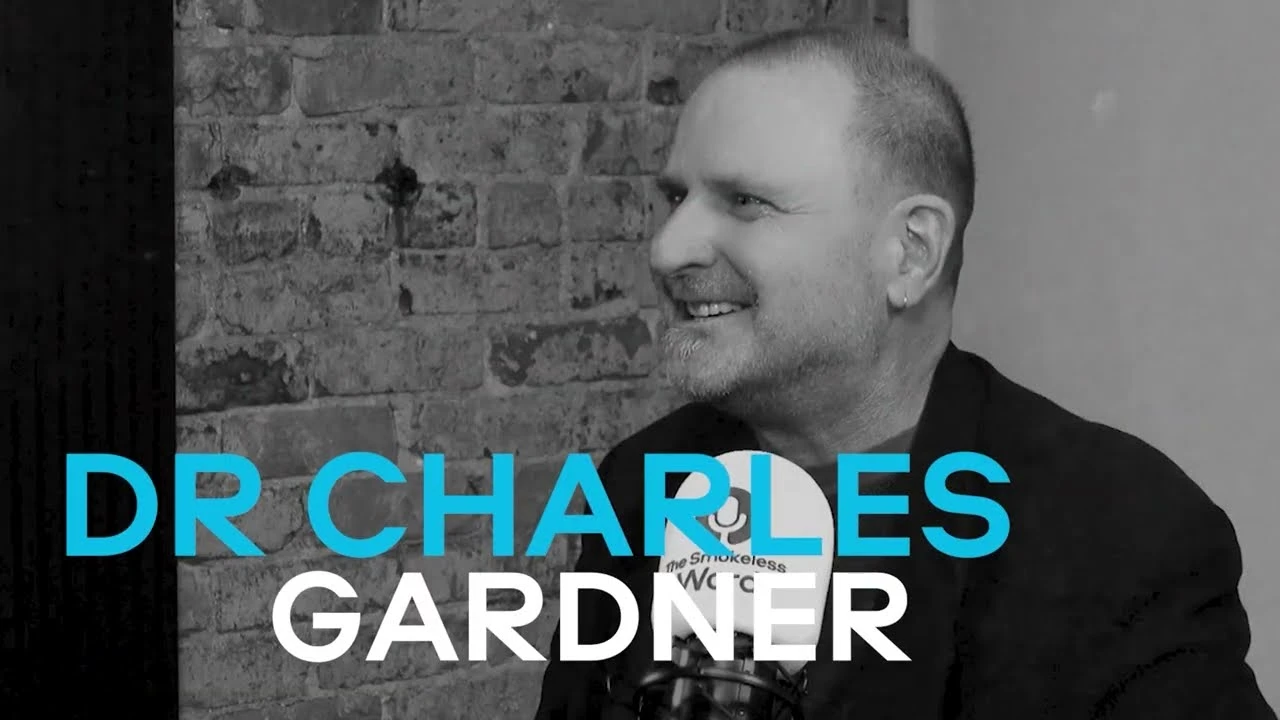
Dr Charles Gardner
Harm reduction is widely accepted in every field of public health except tobacco control. Do you know why that happened? The words nicotine, tobacco, and smoking are used as if they're synonyms. Four out of five doctors are profoundly misinformed. Could you put the case for why we should be implementing tobacco harm reduction as a public health policy. What this really is all about, in the end, is saving lives.
Dr James Murphy
Welcome back to the Smokeless Word, live from the lab. Today, I'm joined by Dr Charles Gardner, a harm reduction expert. Charles and I get into the fundamentals: what harm reduction means, both as a concept and as a public health policy what nicotine actually is and why the voices of ex-smokers might be the missing piece of the puzzle. This podcast is intended for regulators, scientists, policymakers, and investors only. The views expressed in this podcast are the personal opinions of the speaker only. Any references to products having a reduced risk or reduced harm are based on the weight of evidence and assume no continued smoking. This material is not intended for U.S. audiences. Welcome, Charles, to the Smokeless Word. So, what do you think of the studio?
Dr Charles Gardner
I think it was fine. I don't know what Omni means, but well there we go.
Dr James Murphy
Omni, Omni is that that's BAT's manifesto for tobacco harm reduction. So it's our sort of like platform for dialogue.
Dr Charles Gardner
You mean you work for a big tobacco company?
Dr James Murphy
I do. I work for British American
Dr Charles Gardner
Tobacco. A lot of my friends are going to be real surprised that I'm here.
Dr James Murphy
Well, let's get into that then. You know, and we can honour some of those surprises. So I want to go back right to the the beginning because you you've had a really fascinating career, and I I'd love to start at the beginning. You were at University of Michigan Medical School, and I want to go right back to the beginning of you know you chose biology for undergrad, and then you arrived in a PhD in developmental neurobiology. So why why those why those choices? How do how did you arrive at those choices?
Dr Charles Gardner
I talked to a number of scientists. Actually, I thought I might go into parasitology because that was absolutely fascinating to me. And every parasitologist that I spoke with said, "Don't do it. There's no research money for this, so I took that to heart and took the advice of some other scientists I spoke with, who said the big black box of biology, the big unknown, is how the embryo develops.
Dr James Murphy
Yeah.
Dr Charles Gardner
So I ended up into in this field of developmental biology, and the focus I had was on the development of the brain.
Dr James Murphy
You know, when when I look back over your CV, you know, you you've really excelled in academic science. You know, you you've held positions at Howard, you were at Columbia, you've done a whole variety of conferences. But just you know, if what advice would you give, say, like a young budding scientist thinking about taking up science for their career. What advice would you give them?
Dr Charles Gardner
That's actually a really good question. In the United States, in particular, for decades now, biomedical research has been just thriving. The rate of growth of the budget of the National Institutes of Health was just enormous, starting in the 1960 s on through the 70 s, 80 s, 90 s, and it was just a booming field. And in particular, 15 years ago, there was a lot of interest in global health research, so this is everything from treating people in the countries that need it most, low-income countries in particular, to research and development on the development of new drugs and vaccines. For we used to call them well low-income countries, but diseases of the poor. And and it was often long said that 90% of the world's research is spent on diseases that only 10% of the population of the world get, right? Because people like you and me live long enough to get them. A lot of those are cancer, heart, and lung disease, so the non-communicable diseases. But I spent the first 25 years of my career focused mostly on infectious diseases, and a little later on early childhood development issues, which
Dr James Murphy
is
Dr Charles Gardner
brain brain development, especially under five children.
Dr James Murphy
Excellent, and I want, I do want to get into that there. You know about some of the work you did in low-middle income countries and and you know with with with with children. But just just again, just just just at the very very sort of start, just to sort of see what your views and things are. If I just put you in the spotlight. I'd say you know, in charge. What makes a great scientist? How would you react to that? The
Dr Charles Gardner
greatest scientist, and I've known really only a few people like this among scientists. I've known a lot of great scientists, but truly great is someone who can who can discover new evidence, or be told new evidence, and change their mind. And it's such a rare, it's a such a rare capacity. And I and I have worked with some, and worked for some people who I would consider just hyper intelligent, which is not me. It's but it's they were, are, and all of them were like that. I could bring them new information that conflicted with their cherished views and see the gears in their minds turn, and and then it was like, oh, well, then we need to do this instead of that,
Dr James Murphy
that that was a wonderful, unexpected but wonderful answer. And is that humility?
Dr Charles Gardner
I'm sorry. Is it? Yeah, it's
Dr James Murphy
humility. Sorry. Yeah,
Dr Charles Gardner
it is. It be really cautious around scientists who who just like have a really fixed view and are impervious to evidence.
Dr James Murphy
Yeah. So an open-mindedness and willing to accept the may unexpected, right? And then tobacco control is kind of becomes relevant. Very good. That's great. So going back to your sort of early days, you came out of Michigan. You went into I think it was the U.S. House of Representatives. You were you were a committee staff expert, and then you had a whole range of government roles. Can you talk a little bit about about those early years, and then how they shaped you as a professional scientist, and the kind of learnings that you got?
Dr Charles Gardner
So I was 10 years at the U.S. Department of Health and Human Services. Five of those years were at the National Institutes of Health, and kind of like you, I like I was working in the international wing of NIH and covering Africa and the Middle East, and then that expanded to Africa, the Middle East, and South Asia, which is where India comes in, and that meant just facilitating exchanges, working with the U.S. State Department. I was running a U.S.-Egypt biotechnology program for a while, and just a great learning experience. And that led to my position as the health attaché at the univ at the I almost said university at the U.S. Embassy in New Delhi, and so I spent five years in New Delhi, interacting with great Indian scientists who all spoke English better than I do, and but also interacting with the couple of different Indian ministers of health and and ministers of science and technology, and then the leaders of their research agencies, all they're all top notch actually, yeah, truly, and also hosting a number of people like Tony Fauci comes through New Delhi for a an HIV AIDS conference, and I shepherded him around town.
Dr James Murphy
Fantastic!
Dr Charles Gardner
Show him the sights, and the director of the National Science Foundation and the president's science advisor came through, and I took them to see the minister of science and technology. Very interesting conversation that we probably should not go into maybe offline. Yes,
Dr James Murphy
but you made a lovely statement there. I think maybe we can use it later on. But that they're facilitating exchanges. I think there's something in there on collaboration which we could maybe explore as we move forward. If I
Dr Charles Gardner
could add, please. Sorry.
Dr James Murphy
Yeah.
Dr Charles Gardner
We organized nine or 10 scientific conferences every every year, and this is with some U.S. owned rupees that we had discretion over, and so we could we could fly American scientists to India on Air India, and we could also fly Indian scientists to the United States, so there were a lot of exchanges going
Dr James Murphy
on,
Dr Charles Gardner
and so these were conferences on research topics ranging from rotavirus vaccine to HIV/AIDS research to brain research, and always there was a kind of this process of starting with priority setting, what are how do we rank the priorities for potential research collaboration between the U.S. and India? Most of these were academic researchers from the United States and their counterparts from India, some government people. I mean, government research agency people from. India, great learning experience for me, and I, you know, learnt a lot about that. And in the process, created a number of Indo-US research programs, even including one on disability research. So I was very proud of that.
Dr James Murphy
Yeah, the charge. You're, I, I think you know from your background. I think you're in the perfect position to talk about harm reduction as a health policy. You know, because you spent time in government, you're in a NIH, you're at the Academy of Sciences, done time at the World Health Organization. Just to start off, could you define what a harm reduction Policy
Dr Charles Gardner
is, and I've done a lot of work with and learned a great deal from people who work with people who use drugs, by which I mean illicit drugs. And so there's a big move to get people who are injecting heroin to shift to methadone.
Dr James Murphy
Okay,
Dr Charles Gardner
methadone is vastly safer, and it's still addictive, but it's a harm reduction product, and so there are methadone clinics in the UK and in the United States. Still controversial, you know. There's a lot of nimbyism. We don't want nobody wants this near them. These methadone clinics in the UK, for some people, once approved they can just go into a pharmacy and get it.
Dr James Murphy
Yeah,
Dr Charles Gardner
and I think that that makes sense.
Dr James Murphy
Yeah,
Dr Charles Gardner
like people are are always a little weird about drugs. Like we're not very rational about how we deal with everything from alcohol to cannabis to to opioids.
Dr James Murphy
Have you ever been in a in any of these other examples where has any has any of the stakeholders objected to the harm reduction tool?
Dr Charles Gardner
Harm reduction is widely accepted in every field of public health except tobacco control.
Dr James Murphy
Okay, we'll come back to that there in a moment. Then it's quite a very definitive statement. But no, so I want to go back a little bit. You were talking there about the work you'd done in India, the work done in low middle income countries, and you had a whole variety of these different different roles in health and hygiene and and and children. What was important in those topics that drew you to
Dr Charles Gardner
them? The goal to save lives. I was intrigued by the kind of the philosophical issues surrounding the concept of innovation and strengthening innovation in and by researchers in developing countries and public-private R and D partnerships and and so I learnt a lot from innovation economists of all people and and held some conferences when I worked at the Rockefeller Foundation, we had some meetings at the at the Rockefeller Foundation's conference centre in around Lake Como. What's it called? But in any case, a senior moment. And so I, these were some of the world's top innovation economists, and but we were all focused on the health side of things. So I bring that to India when I go there, and we launched an Indo-US technology management program, and it was really about how you have all these publicly funded research institutions in India, some of them are top notch. Many of them, how do they enter into partnerships with their own private sector in a way that still protects the public interest? Is not selling selling the shop and and selling out the public, And so it was just I was you know inspired by the intellectual issues surrounding that and some of the preconceived ideas you know rejecting that initially as much as by the overriding goal of what this really is all about in the end is saving lives.
Dr James Murphy
Yeah, could you put the case for, you know, why why we should be implementing tobacco harm reduction as a public health policy?
Dr Charles Gardner
Yeah, it's it's lovely to hear that in your accent because I heard put the kiss in. So I will tell you, this is well thought out. I mean, long before I came into the field of tobacco control, and I, you know, that I used to teach healthcare ethics to medical students, and I was keenly aware all. The time I was working on infectious diseases and child health, of the enormous death toll from smoking, and my my own father at that time was already sick with chronic obstructive pulmonary disease, and he had been a heavy smoker. And but to be honest with you, I didn't want to touch tobacco control with a 10-foot pole, because as far as I could see, the only health interventions available were stigma and coercion. By coercion, I mean things like sin taxes and prohibitions bans, and you know that's all for our own good. It's a they're paternalistic kind of utilitarian solutions to a problem that really affects individuals. If you work at the bedside, you you care about a person's autonomy. These coercive measures violate autonomy, which is a fundamental moral principle in healthcare ethics. Truth telling is another big part of of autonomy. Your patient needs to be informed, right? You you know you have this disease, you might have that disease. We, you know, we're not sure yet. We're going to try this medicine and see if it works, and then if not, we're going to go to the other one. And the patient needs to be informed. I saw a lot of, I thought I saw, and I definitely see now a lot of harm exaggerations in the field of tobacco control. Even at the time, I was aware of this concept. There is no safe tobacco product. That's kind of a lie by omission of context, in the sense that there is wide even before e-cigarettes came along, and I had no knowledge of snus at the time, but there were there were what there were cigarette mass-produced cigarettes, there were premium cigars, cigarillos, pipe tobacco, and what we called American Chew, American chew back then, and it just it struck me. Well, you don't inhale that; it can't possibly be as harmful as a cigarette, and that just like plain as day. That's the case, and so I I didn't like those little white lies for our own good paternalistic white lies, and so I thought it was a little just something off, something wrong. Now, when the only reason I came into the field of tobacco control is that I discovered that there are harm reduction options, that there are health interventions. This is the way I see the harm reduction products as health interventions, and that that can save millions and millions of lives. And we don't need to remind people that cigarettes kill 7 million million people every year in the world. 80% of those people are in low and middle income countries. A surprisingly high percentage of those people are men. So I think I think I I I am one of those people, and I think there are many of us in public health that have made this slow transition from being skeptics to embracing the harm reduction on the tobacco control side, and now it's it's fair to say, in like in the remember, I used to be a diplomat. Well, there are two schools of thought on this now. There's absolutely no question that there are well-meaning, highly trained experts on both sides of a debate, and the unfortunate thing is, they're not talking to each other, and they don't trust each other. But and a number of people who I respect a great deal, who had, who were deep skeptics of the harm reduction products, by which I mean, say, for nicotine alternatives. Deep skeptics have looked at the evidence and changed their minds and shifted over to the harm reduction side.
Dr James Murphy
But I'd like to go back because you you know you you have a couple of different experiences. I'd like to sort of get your view on. You know you talked about dealing with the the individual. Then you know you also talked about you know at a national level and you know in the UK we have the National Health Service who's very clear views on e products like e-cigarettes and nicotine and the risk pro the lower risk profile relatives of smoking, but then as you go down I suppose through the through the through the ranks of the medical community, that the message at the top doesn't seem to permeate down to the the sort of soldiers on the front line. Do do do you know why that happens or or what could be done to to improve that that message going down?
Dr Charles Gardner
So we we need to think about the history of this four decades of tobacco control research publications and messaging. In if you look back through the history of that and and even scientific publications, the words nicotine and tobacco and smoking are used as if they're synonyms. They're used interchangeably, so that has created a great deal of confusion. In fact, it's actually difficult to understand what they're talking about in some scientific papers because they they just use these words interchangeably and as synonyms. So so that you know these are different things. That's created a confusion, in particular about nicotine, and we've seen surveys in the United States, but also in India. And physicians in the UK are a little bit less misinformed, but in the United States, 80% and in India, 80% of physicians believe incorrectly that nicotine causes cancer, and heart disease and lung disease. So it doesn't, and nicotine itself doesn't cause those things. It's inhaling all the chemicals and the carbon monoxide and solid particulates from a cigarette that do that, but we can say four out of five doctors are profoundly misinformed now. For me, the question then becomes, okay, who misinformed them? This doesn't, and it didn't happen by accident. So, for example, you can go back to the 1960s, and most Americans in the public assumed that chew tobacco was safer than smoked cigarettes, which it is. It's not risk-free, and it still can increase the risk of head and neck cancers. However, it doesn't do that as much as cigarettes do.
Dr James Murphy
Yeah,
Dr Charles Gardner
and and so Americans had a correct view on the relative risks and the relative risk difference back in the 1960 s. But as time progressed and the messages and the messaging from tobacco control, you know, kept hammering in. At this point, most Americans think they're equally harmful now. So we're-it's sad to say-but we're dealing with a whole field of public health that makes the public as well as physicians more misinformed rather than better informed about their health options,
Dr James Murphy
and you know it's it's you know the the misinformation it's it it's it's prevalent it's out there in society, but I look at harm reduction as a theory in in the world of tobacco, I look at what happens, say in Sweden, where you know Swedish males switched from smoking to using snus, and then you see they have the lowest incidence of smoking-related disease in Europe. And I see today we're BATs in about 150 markets around the world. I see in countries like Japan, we have our business in Japan is over 50% smokeless. Yeah, you know Sweden or our business. It's a great success. 80% smokeless. The UK is now there's more of the the vaping prevalence in the UK is actually higher than the smoking prevalence. So even even with all of the misinformation that's out there, we're still seeing some of these really transformational stories happening. How would you react to that? There.
Dr Charles Gardner
So it was important to note that in Sweden, the percentage of the adult population that are using nicotine products is almost identical to the average in the European Union.
Dr James Murphy
Yeah.
Dr Charles Gardner
But their smoking rate is vastly lower. It's around 5% now. Some people are arguing it's less than that, and so I'm seeing different numbers. But the smoking rate is much lower, and their death toll from. Tobacco or nicotine products is vastly lower than the EU average. I mean, right there you can see it's not nicotine that's causing the deaths. The countries that are now in a position similar to the UK, where the number of adults using safer nicotine alternatives has well, it's displaced the number who are using the deadly alternatives, and so there are more people using the safer rather than the deadly. is is not small. Still a handful. The United States is there, and Sweden, obviously, Norway and Iceland are there. New Zealand is there. New Zealand is a bit like the UK that they've actively promoted nicotine vapes for adults who smoke, and there are a number of countries that are right on the verge. I give credit to the former Attorney General of Iowa, Tom Miller, who has coined the term THR countries, so tobacco harm reduction countries. These are the countries where the number of people who are using the safer alternatives now exceeds the number who are using deadly cigarettes. You can see in the United States the trend in declining cigarette smoking was one or 2% for four decades, and it's now 5% every year, according to Goldman Sachs, according to the Federal Trade Commission. There's agreement, and the CDC use numbers are showing the same thing, so the decline in in smoking is accelerating, and it's not just e-cigarettes. I think I get associated with e-cigarettes all the time. I talk about them a lot because they're just the most controversial. But Americans are using snus to some extent, and and now these relatively new nicotine pouches are just like selling like gangbusters, but to adults, not to kids. In fact, the number of kids using them in the United States has just gone down, and it's already extremely low.
Dr James Murphy
Yeah.
Dr Charles Gardner
And so the United States is a THR country, and we're going to see some more coming online and and joining. We have a thing called the Tobacco Scorecard Number Two that lists all of these all of these countries and why what the data are.
Dr James Murphy
Very good, and and and then so just to ensure balance, do you see any gaps in the tobacco harm reduction strategy that that you think should be addressed?
Dr Charles Gardner
Well, there isn't one strategy, right? You have the World Health Organization strategy, and in any World Health Organization documentation, the words harm reduction only appear in close juxtaposition with industry interference. So the the case is made that harm reduction is something concocted by an industry to really to justify keeping people addicted to nicotine. I would say nicotine is not the problem here; it's dependence forming, but it doesn't kill people, and we can certainly see that with nicotine patches and nicotine gum because they're on the World Health Organization's essential medicines list, and so so that's kind of the extreme end of of one side of the case, and the other side is what are we missing in the side of of people who and good scientists who have accepted harm reduction. And I created a hashtag four or five years ago, half jokingly, that got popular for a while, called "Old Farts Vaping, and the idea was send a selfie if you're over the age of 40, and and you and you you look kind of grizzled and and and and ugly, and if you're an older person, because 21 million American adults are vaping nicotine now, and and the the smoking rate is plummeting, and if you look at the trend line, almost no one is going to be smoking in the United States in 10 or 15 years, and the same is true in the United Kingdom, and I mean, to me, this is good news. We should all be dancing in the streets. I think that we're already starting to see lung cancer incidence, as well as deaths. First, well, at least they're continuing to drop despite a. Massive, massive product substitution that's been going on for two decades now. Deaths probably dropped because you know the treatment got better, but diagnosis technology has also improved. So you would think that incidence, which is new cases would increase now, that's that's going down. So, so on the on the harm reduction side, we're missing the voices of people who have basically what the World Health Organization might say have quit the wrong way.
Dr James Murphy
Yeah,
Dr Charles Gardner
with the harm reduction that dare not speak its name,
Dr James Murphy
like the testimonials and that sort of thing. Yeah,
Dr Charles Gardner
exactly. They need. I also have tried to learn a lot from cannabis advocates. I I don't use cannabis, but I have nothing against it. And one of the things they said that that helped to tilt the Needle was the discussion around medical cannabis, or what is it called? Yeah, medical medical Marius. Got to have the alliteration to make it, you know, have resonance. And so it was getting it was getting old people who was who were recovering from chemotherapy on camera talking about how this helps them, it alleviates their pain, it helps them sleep at night. And if you look at the National Academies of Sciences, Engineering, and Medicine report on the health effects of cannabis and cannabinoids, which I have read, that there's a strong case for that. Very high, strong evidence for that, so it was talking about potential health benefits of cannabinoids. Well, okay, harm reduction on the tobacco control side. There's a potential health benefit of not smoking because I think we're ethically obligated to try to get it to the people who need it the most, which is adults who are still smoking.
Dr James Murphy
You were talking there about some of these markets that have had smokeless products for well over a decade. You know, 15 plus years, like the US, like the UK, like you know Japan. I think is is probably about sort of 1314, years of heated products. And what's really interesting, being a scientist now, is that whenever you see products like that being in in those markets for such a long time, even in Japan now, you're starting to see some publications from some academic groups where they're showing that in areas in Japan where heated product prevalence is high, hospitalization rates are reducing, so I think it's a it's a it's a fascinating time to be a scientist to now to really see product switching and how it's impacting population health.
Dr Charles Gardner
Both you and I believe that in the harm reduction evidence, which is I would say, overwhelming right now. So, the instant you believe that, as I said, there are two schools of thought. So, the instant you're you accept that, it is inevitable as we watch these smoking rates drop. That well, lung cancer is 29% of all smoking-related deaths. That's that's going to be one. It's like the canary in the coal mine. That's going to be the first thing that we notice dropping. That appears to be the case in the United States, according to the National Cancer Institute at the National Institutes of Health, where I used to work, and and other cancers as well. So cancers total 36% of smoking related death. Cardiovascular disease another 36% I think you know there's some hints that that's dropping despite the increasing American obesity. Although with these new diet pills, maybe that's going to reduce cardiovascular disease. Might be good, although we don't know the long-term effects of those medicines.
Dr James Murphy
Yeah,
Dr Charles Gardner
but and then chronic obstructive pulmonary disease, 21% of all smoking-related deaths. That's what killed my father, and it's it is not a nice way to go, and that's going to be dropping as well. And there's some signs of that in the U.S. evidence that I've looked at. We're going to see it's going to it's going to become more and more difficult to stick with being a harm reduction skeptic.
Dr James Murphy
We often summarize, you know, why do people smoke, and it's it's the nicotine pharmacology, it's the sensory, and it's it's the ritual. And if if you're if you know you and I grown up probably around the same sort of time, it's perfectly understandable for us that the risks of nicotine are probably. Conflated with the risks of smoking because years and years ago there was only cigarettes, but now we're in this world of smokeless products. I feel that this is a real barrier to, you know, to people switching. I feel like it's a barrier for the you know regulators, policymakers to be able to accept smokeless products and and tobacco harm reduction as a concept. Is there is what more can be done to sort of explain and communicate what what what you were just saying there?
Dr Charles Gardner
Yeah, I mean it's all very ironic because we're in the process here in the United States of demonising, de-demonising cannabis cannabinoids, which we demonised ever since Reefer Madness in the 1930 s, which by the way basically put the kibosh on it. It prevented a lot of good research that could have been conducted on the potential health benefits of and cognitive benefits of cannabinoids. The same is true of psilocybins, which are hallucinogens. Oregon legalised those a couple of years ago. The president has recently changed how they're categorised so it will be easier to do research. The preliminary trials show that what's called psychedelic therapy is-it's gangbusters. It's incredibly effective for people with either chronic depression or even with PTSD, in in just a one day treatment, so that should you know make people wake up and something that we've demonised since 1968 when the that was prohibited. But the prohibition, the prohibition of the drug also prohibited the research. So the research wasn't done. You think of all those young men returning from Vietnam with PTSD. It just breaks my heart. We need to get to a place where we begin to think about demonising nicotine, you know. And so the irony is, we're de-demonising some substances, and we obviously in the United States we demonised alcohol and then we de-demonised it. So we Americans love to do this stuff, and but nicotine, if anything, the war on nicotine it seems to be heating up. So we need to take a couple steps back, separate it from the cigarettes.
Dr James Murphy
And Charles, you know, two two things I'd like to I'd like to get your your views on. What I really like about your background in this conversation is you're someone who has operated at government, so you're you're at the macro view, but you're also someone who has, let's call it, been on the front line. So you've seen you've seen both sides both sides of the story. And and you talk about the smoker and and switching. What's your view on things like flavours, where you know they they seem to be important for for smokers to be able to switch away from from cigarettes to to smokeless products. Yet there seems to be you know a lot of concern because that there apparently drives you know youth appeal, etc. etc. And just for the record, no youth should be using a nicotine product. Fully agree.
Dr James Murphy
What's what's your reaction to that?
Dr Charles Gardner
I think the assumption that either that flavoured vaping products or nicotine pouches cause teen use, or or in many cases it's argued that those flavours are added in order to lure teens, I think it's an unexamined assumption at best. If I often point out, so nicotine gum has been around for decades.
Dr James Murphy
It's
Dr Charles Gardner
available over the counter in every pharmacy in America to help people quit smoking, and kids don't use
Dr James Murphy
it. It
Dr Charles Gardner
comes in fruit flavour, fruit medley, cinnamon flavour, mint, and menthol flavour. Big Pharma makes it, and they don't make a tobacco-flavoured nicotine gum. And by the way, we're talking about something that is literally a candy, and it's flavoured, and kids don't use it, and it delivers nicotine. Big pharma doesn't make a tobacco flavour. Why? Because they know that no one trying to quit smoking would ever buy that. And so, if people don't use it, it's not going to help them. Something can be efficacious in laboratory experiments for smoking cessation, but if no one uses it, it's 0% effective. And I often also now point out the sales and availability of flavoured nicotine vapes skyrocketed in the United States over the past five or six years, and that's no question. It actually sales quadrupled over this very brief time span, and over the same time period, the number of teens who were vaping nicotine dropped by 74% according to the CDC, FDA, National Youth Tobacco Survey. So it's very clear those flavours are not driving teen use because teen use is plummeting. Now, a lot of people who work in tobacco control don't believe that vaping is going down, and so I mean that is a another interesting question that is a whole different conversation. But that's the same survey that the the FDA used in 2018 to claim epidemic.
Dr James Murphy
Yeah, but but it's it's a bit back to your you're probably one of your first statements when you were saying, you know, when I asked you, you know, what makes a great scientist, and and you were saying that that that that breadth of mind to be able to change your mind.
Dr Charles Gardner
Yeah,
Dr James Murphy
there's something in there. Is it that like, you know, is is the breadth is the breadth of mind there to be able to accept that flavours doesn't drive youth uptake? That that that seems to be one of the challenges.
Dr Charles Gardner
Yeah, people need to distinguish between what they want to believe and and basically what evidence from the real world actually shows? Yes.
Dr James Murphy
Yeah.
Dr Charles Gardner
Obviously, your taste buds didn't change the instant you turned 18 or 21. Nor did mine. Lots of adults love flavours, and the data show that 80 to 85 percent of adults who are vaping nicotine are using flavoured vapes. So when you talk about eliminating flavours, you're taking products away from 85 percent of the ex-smokers who were using that product to stay smoke-free. What do you think is going to happen, right? Some of them are going to relapse to smoking. Others will turn to an illicit market. Let's be honest; that exists because the FDA prohibited flavoured pod-based vapes in February of 2020. But I think the The real challenge here is to get people to shift from thinking about what I would say is the top priority, which is to reduce preventable cancers, heart disease, strokes, and lung disease, to where a lot of people and a lot of experts in tobacco control are now, which is where okay, the end game is now to eliminate all nicotine use. Yeah,
Dr James Murphy
Charles, it's been such a wonderful conversation. Learn about your background. I'm still really taken by that statement on the great scientist. That that that kind of humility, that that's going to stay with me for a while. I really enjoyed that, and then just just that walk through harm reduction and how we can communicate better. I do have a couple of more sort of fun, quick fire questions, but on on the podcast, we like to give the the guest an opportunity if if they if you wanted to ask me any questions.
Dr Charles Gardner
So, you work for a big tobacco company, I hear, and you work on the harm reduction side. The only people I've ever interacted with in in the tobacco industry, have been those people. It reminds me very much of when I was working at the Rockefeller Foundation, and and we were working on trying to get drugs and medicines to people who needed them most in low-income countries, especially in Africa, some parts of South America, and and I was working with people in big pharma then, but only with the people who were involved in their drug donation programs, massive drug donation programs. They didn't even tout them. They put put out no press release, nothing. They were it wasn't quite. Out of the goodness of their own hearts, but they but they were doing it for basically good reasons, and doing it in every case basically because their CEO said we're going to do this over the objections of their bean counters. So in a big tobacco company, your CEO says one thing, your bean counters say something else. Right? We have to keep an eye on total revenue from all of our products, and there is no doubt that the safer nicotine alternatives cannibalize your cigarette, which has been your your cash cow for decades. You don't have to worry about that because your job is to promote the harm reduction products. But there must be internal discussions surrounding that Juxtaposition of interests. Yeah,
Dr James Murphy
so I mean, as well as being the the the our director for research and science, I also do sit on the managing board of the company, and I report to the chief executive. And you know, so the chief executive, he he we we rearticulated our strategy back in 2023, where we said we wanted to be a predominantly smokeless business by 2035. So by 2035, we we we make we over 50% of our business is in smokeless. That's an ambitious goal. So so that that was the goal. So down through the organization, I think one of the greatest myths is that you know about the commercial value of the smokeless products. Commercially, now we're getting to a point where these these products are very close to being as commercially viable as the cigarette business. So that sort of thing of the cannibalisation, you know, we we welcome the switch because from a from a commercial revenue perspective, we're we're not losing out.
Dr Charles Gardner
Now, I had thought that e-cigarettes, the the margin on e-cigarettes was was lower than on on cigarettes, and and that that was largely due to the fact that there were so many independent players that were not traditional tobacco companies.
Dr James Murphy
Well, the the thing is, for us, is we we just want to have an equal regulated marketplace. You know, I think at the very base, I think the consumer should expect and should be offered a product that's well made and well stewarded in terms of the ingredients, the materials, and that's really, I think, you know, in Europe, that's kind of the the the way the regulation is set. So there's there's not it's it's a notification. It's it's not an authorization process. So you you don't have to get an authorization from a regulator in France. You apply. There's a time period somewhere between three and six months, and then you can place your product in the marketplace. So that I think that creates a more even marketplace. But going back to your your,
Dr Charles Gardner
if I could also add though, you're also beholden to your investors.
Dr James Murphy
We are indeed right
Dr Charles Gardner
if they're not happy with the revenue coming in, they're going to force you to change your your business strategy, and your business strategy right now is to shift from the traditional cigarette sales to safer nicotine alternatives. I applaud that, and what's also interesting is that your investors are not pushing back on that. Yeah, there's,
Dr James Murphy
there's a. I mean, to speak in commercial terms, there's there's a sustainable business model there, and just if I just just one more maybe other point from from a global perspective, because sometimes you know if you can look in the world and it's a it's a it's a it's either black or it's white, but we're we're in 150 markets, and we have markets where 80% of our business is is smokeless. Many of our markets were largely smokeless, as you know, markets were 20 30% We but there's still these laggard markets who don't permit the sale of of smokeless products. You know we've got quite a few in South America, Brazil. You know, we got Turkey. So, if these and these are markets where there's millions of people using the using products an illicit market. So, if these could be opened, I I think you'll see companies like BAT and others shift even faster.
Dr Charles Gardner
Well, that's a good point because if it's an illicit market, it's not you know not products made by you guys. I think it's a puzzle to me. Mexico prohibited e-cigarettes. And then they went a step further, and they wrote that into their very constitution, which is the kind of bonkers thing we did with alcohol in the United States in 1920. And then we had to have a whole no other constitutional amendment to get rid of that. When everybody realized we just turned our entire nation into a nation of criminals. That was whiskey being delivered to the Senate office buildings. So the fact that I think 4648, countries now have prohibited safer nicotine alternatives, while leaving deadly cigarettes and biddies, in the case of South Asia, widely available, legal, and sold on every street corner. It boggles my mind because we we we know exactly how harmful those products are, right? So sticking to your guns and saying we want to get rid of those novel nicotine products, and there's an assumption as well that if there's more variety of products, then there's going to be more nicotine use, right? That's not the way it works. These are product substitutes. I think unfortunately a lot of people in public health, didn't take econ 101 in college because of the concept of product substitution. You know, it's not additive; it's substitutional. So, so the graphs I draw.
Dr James Murphy
Yes,
Dr Charles Gardner
for example, I gave a talk at the Harvard Club in Manhattan last fall, and I showed up a graph of a trend line going going up, up, up, and another one going down, down, down over the past five years, and the the labels were: this is sales of electric cars, and this is sales of combustion engine cars. And I said, well, you know, everybody understands what's happening here, right? So electric car sales are displacing combustion car sales. Except I said the the labels are wrong, and then I switched to the next slide, which was well, actually this is what the CDC National Health interview survey shows for adult smoking and adult vaping, and adult vaping was has increased 110% in just a five year period, and increased by 11 million adults in the United States. And how many fewer adults do we have in the United States smoking, according to the same survey? 11 million fewer adults. It's it's more complicated than that because there's dual use and people in transition from smoking to to vaping, but the net effect is clearly product substitution
Dr James Murphy
in the
Dr Charles Gardner
right direction, from a deadly product to a safer product, I see nothing but good news in that. Yes,
Dr James Murphy
yeah, and and if if there was more countries like this here, it would be wonderful. The
Dr Charles Gardner
THR countries, right? So yeah, the UK is there. Canada will be there very soon. Italy, surprisingly, will be there. I think Denmark will be there. Yes.
Dr James Murphy
Yeah.
Dr Charles Gardner
And so this is all good news. It's it's going to become, as I said, more and more difficult to be a harm reduction skeptic.
Dr James Murphy
Fantastic. I want to finish off with a couple of quick fires for you. So, your hero.
Dr Charles Gardner
Well, I really haven't thought thought through who my heroes might be. You know, I'm I am an armchair historian, so I like I instantly go back to people like Darwin or Galileo. Galileo actually confronted a challenge similar to the to the to the phase transition or the or the paradigm shift that we're seeing in tobacco control today, but 400 years ago it was from geocentrism. So the Earth is yes, it's round. Everybody knew it was a sphere, but it's fixed. It doesn't move. Everything goes around the Earth to heliocentrism. Everything goes around the Sun, and he was put put put under household arrest for the rest of his life, and and barely escaped being burned at the stake. Now, in tobacco control, if you're a good scientist and you now suddenly change your mind and say, "I think you know harm reduction might be right, and you start researching it and so on, you may not be invited to speak at the next tobacco control conference. You may find your papers getting rejected by. The journals you may face criticism from your colleagues who you've worked with for for decades. It is the academic equivalent of being burned at the stake. So this that kind of tension is there now. Galileo, Hero, Darwin. I mean, I've read The Origin of Species I just, you know, what a brilliant insight. Along with, what's the other guy starts with a W, Wilson Wilkinson. But my bad, but they're really co co discoverers of the the theory of natural selection, and Louis Pasteur. I wrote. I wrote a speech, a speech for Bill Clinton once on the some big anniversary of the death of Louis Pasteur. He never gave it because suddenly this controversy erupted in France about the attention between the U.S. and the and the French researchers on the patenting of of an antiretroviral drug, and but so he so he he pulled out of that, but the White House speechwriter like called me up, said that was a great speech. So I felt pretty good.
Dr James Murphy
Very good.
Dr Charles Gardner
Yeah, go on. So
Dr James Murphy
the next one, a surprising fact that people may not know about you.
Dr Charles Gardner
Well, I can juggle.
Dr James Murphy
No way.
Dr Charles Gardner
Oh yeah, I'm actually quite good at juggling lacrosse balls. Oh, how many? Quite heavy.
Dr James Murphy
Yeah,
Dr Charles Gardner
three.
Dr James Murphy
Great. Yeah.
Dr Charles Gardner
But the number of patterns you can do with like even crossing your arms over and the claw and and is many. And I started doing this in college with a friend, and he was really good. Oh, he was always better than I was. I dropped the balls every now and then. And I was once chased by a bull elephant in West Africa. That I guess people wouldn't know that about me. He was really, really angry, and and I was running, running, running like hell, jumping into a car with all four doors open, and and it was already moving. And but I, but I lived.
Dr James Murphy
Very good. Your favorite thing to do on a day off?
Dr Charles Gardner
I don't really take days off, and that. So this is, this is a troubling thing about me. Maybe like latent OCD like symptoms, which is, I get up in the morning, I have my cup of coffee, I go straight to social media these days, and this is how I keep my finger on the pulse of what's being said and thought, both in the community of ex-smokers who have quit with safer nicotine alternatives, which is quite huge. And again, voices never heard. And but also, what's you know the new science that's come out, new publication, scientific publications. We read them. It's actually it's incredibly heartwarming how many people with no scientific background in in that community have taught themselves how to read a scientific paper.
Dr James Murphy
Well,
Dr Charles Gardner
right, and you know even the methodology section. Yeah, but at least read the abstract and understand what's being said, and it's it's it's quite impressive. Ultimately, everyone is self-taught in the end. It's a line from a Kurt Vonnegut novel, and and actually a favorite of mine, And so, so I I'm there, and one might say what I'm doing is obsessive,
Dr James Murphy
very rewarding.
Dr Charles Gardner
But I'm also going out there and looking for people who are saying things that are demonstrably false.
Dr James Murphy
Yes,
Dr Charles Gardner
and I've had to learn over time how to do that, well, as respectfully and politely as possible. I don't always succeed. I get cranky sometimes, but you know it's like okay, it's interesting. Or I respect you know your right to believe that, but here's what the surveys actually show, or here's what you know these peer-reviewed papers actually show, and it. And sometimes I just think we need to change perceptions. You can only change people's minds, like one mind at a time.
Dr James Murphy
That's right. But it's-I always like the way you're trying to draw back to the evidence. Absolutely,
Dr Charles Gardner
it's yeah. It's all about the. In fact, people have blocked me for simply sharing evidence that doesn't fit their preconceived ideas.
Dr James Murphy
Often government evidence, governing surveys. Yeah, absolutely. I mean, it's yeah, it's
Dr Charles Gardner
official government surveys from the Health Canada, from CDC, from FDA, from NIH, from the National Health Service in the UK from Ash UK, which is not government really, but but it and and other government agencies from the Ministry of Health of New Zealand from the Ministry of Health of Kenya, you know the good news is the news is better than what the screaming clickbait headlines are telling the public right now.
Dr James Murphy
Yeah. Now this one, this next one, it'll play to your internationalism of the countries you've worked in. Favorite food type?
Dr Charles Gardner
Oh, Thai food, hands down.
Dr James Murphy
Yeah.
Dr Charles Gardner
And very spicy.
Dr James Murphy
Very good.
Dr Charles Gardner
In fact, when I go to a Thai restaurant. I I now have a. It's like a routine of telling someone whose first language is not English. I I want this Thai spicy, right? Okay, that doesn't always go over well because people see my face, and so plus I'm also telling them no bell peppers, so that confuses them, because I I don't like bell peppers for some reason. I want spicy as hell, and I want some extra prik nam pla, which is the chopped up chili peppers in fish sauce. Yeah,
Dr James Murphy
yeah.
Dr Charles Gardner
And and I load it on, and I'm just like in a glazed state of ecstasy, eating. By the way, there you're eating capsaicin. That's the that's the molecule that causes the heat. Capsaic capsaicin or capsaicin or whatever you pronounce it triggers substance P cells in your mouth, which are are pain fibers that go directly to your brain and trigger the release of dopamine, and of and endogenous opioids, endorphins. Struggling for the word of endorphins. So you're basically you are getting something like a runner's high if you eat enough, enough so that your scalp is sweating. But no, and I know how to cook some Thai food myself. Can make a I can make a damn good tom kah gai soup.
Dr James Murphy
Excellent.
Dr Charles Gardner
It's actually remarkably easy.
Dr James Murphy
Yeah, but delicious. Oh God! And then the very last one, favorite book.
Dr Charles Gardner
Ooh, tough one. Probably 100 years of solitude. I think I've read it twice. I I was just in awe. There are other books that I've been in awe of, like all the what is it? All the all the King's Men. All
Dr James Murphy
the King's Men, yeah. By
Dr Charles Gardner
Robert Penn Warren. It was just like there were times where I had to stop and reread a whole paragraph to just like figure out how he did that so beautifully. Gabriel García Márquez in One Hundred Years of Solitude is is like that, and in fact, he contributed to the translation of of the book from Spanish, which is the original, into English.
Dr James Murphy
Yeah,
Dr Charles Gardner
and he spoke English quite well, but he he needed a native speaker to to do the the final touches, and he supposedly said he liked the English version better.
Dr James Murphy
Wow!
Dr Charles Gardner
And the reason is, there are more words in English.
Dr James Murphy
Yes, a larger vocabulary. A
Dr Charles Gardner
lot more words. So for any idea, concept, emotion, you know, there are more nuance, different words that you could use in different contexts, which is interesting,
Dr James Murphy
but it's great to see someone at the height of their powers, isn't
Dr Charles Gardner
it? Oh my goodness! Some of his other books are good, but that was quite monumental. He received a Nobel Prize in literature for that, I think.
Dr James Murphy
Yeah, fantastic, Doctor Charles Gardner. Thank you so much for coming on the podcast today. It was a fascinating conversation. So thank you very
These transcripts are AI-generated and may contain errors or inaccuracies and should not be relied upon.
Dr Charles Gardner was once sceptical of tobacco harm reduction. Now he’s a tobacco harm reduction expert. He joins The Smokeless Word: Live from the Lab to discuss what changed his mind, the evidence shaping the debate, and why listening to people who have switched matters.
From the misconceptions surrounding nicotine to the evidence from countries embracing smokeless products, Charles unpacks with Dr James Murphy, BAT’s Director of Science and Research, the case for tobacco harm reduction and why the voices of those who have switched could be the missing piece of the conversation with policymakers and public health officials.
Join James and Charles for a conversation about challenging assumptions and following the evidence.