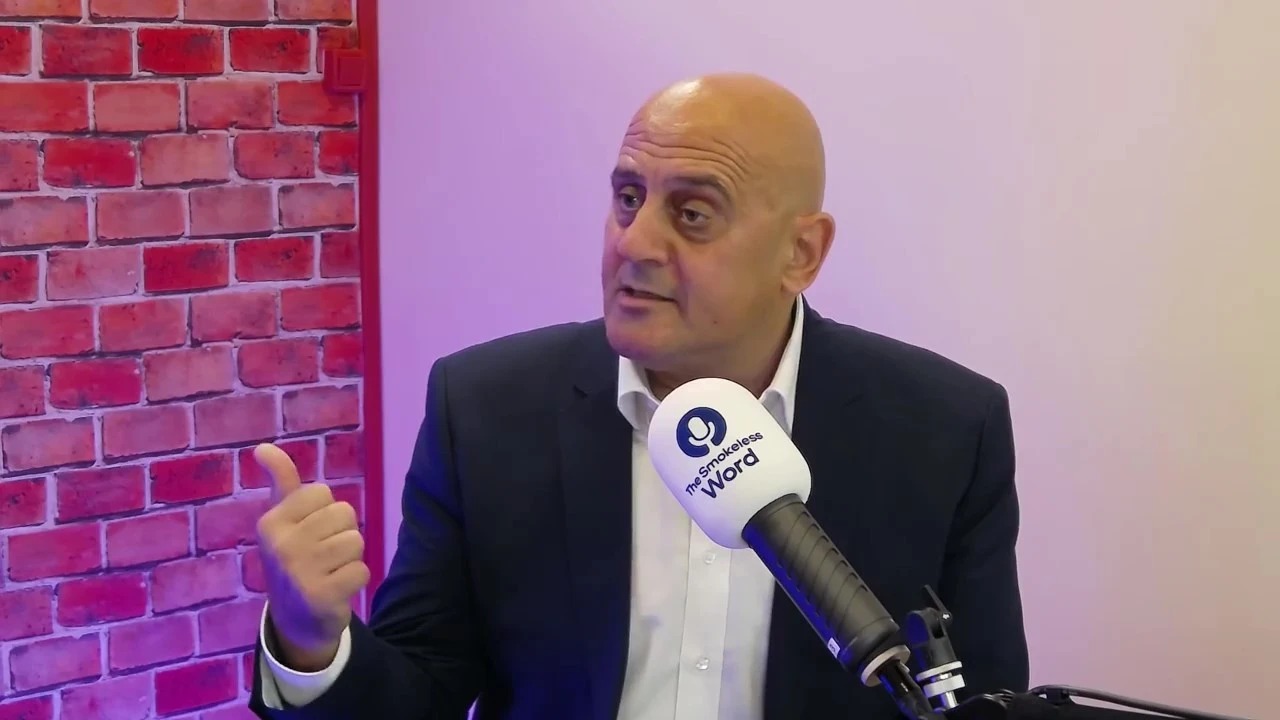

Episode 7: Theo Foukkare
Kingsley Wheaton
Kingsley Wheaton Theo Foukkare This podcast is intended for regulators, scientists, policy makers and investors. Only the views expressed in this podcast are the personal opinions of the speaker. Only any references to products having a reduced risk or reduced harm are based on the weight of evidence and assume no continued smoking. This material is not intended for us audiences. Welcome to the latest episode of the smokeless word coming to you from Brussels today. I'm really excited to be joined by Theo Foukkare, the CEO of the Australian Association of convenience stores. Theo and I will talk about the so called largest policy failure in history regarding tobacco tax, the rising smoking rates in Australia and the impact of organized crime. I hope you enjoyed the episode. Theo, welcome to the smokeless word. Thank you for joining us. What do you what do you think of this Brussels studio?
Theo Foukkare
Thank you for having me on and I love the studio cozy, obviously promoting Omni, Omni. I'm sure we might get to speak about that a little bit. But, you know, I think you're what you're trying to do in terms of transform the way that consumers look towards, you know, the way forward out of smoking is remarkable, and I think that it's a testament to yourself in the organization to take such a proactive position on moving the dial and having open, honest, independent conversation about this.
Kingsley Wheaton
Yeah, no, we were a determined to try and be transparent and have a kind of new way to have a conversation. Tell me, talk to me, sort of about your career leading up to joining acts in 2021 maybe just for the listeners. Give them a bit of a history of what you did and how you found yourself in that position four or five years ago.
Theo Foukkare
Yeah, look at some. I've had an interesting journey. So I started out of university on the graduate program with Rothmans at the time in Sydney. So I spent six years with Rothmans, which became British American Tobacco when they went through the merger with WD and H O wills. Fantastic platform to be able to build my own personal capability in a number of different areas. From there, I actually met the owner of a company called Pacific optics on an overseas retail tour, and we got on he explained to me about his business, and I think at the time, there were sort of 10 staff. They were bootstrapped. They were growing their business, but it was literally one person that was running the business, the main shareholder, and he sort of said to me, do you want to come on board? And I thought to myself, Wow, some really small company, $6 million turnover at the time, and I was leaving this large, global organization with, you know, a potential career path moving forward, relocating states, so from Sydney to Queensland. And thankfully, I had the support of my wife. She was like, You know what? If you feel like it changed, let's go. And I think over that 17 year journey. We went from a really small family business to a really big family business, and I think I played a key role in building that business up to 150 staff. And I think I sort of got thrown into the deep end because, you know, working for a large corporate, you sort of have your areas of responsibility. But in a small family business, you sort of do everything you got to, everything, everything. And, you know, I think that provides you with the ability to learn very quickly in some cases. But for me, it sort of allowed me to stand up and show my true leadership qualities and and I think what we did, you know, when I ended up, sort of in 2017 when we sold the business at 150 staff, and, you know, I think when I look back, it was kind of that journey, and the changes that we made through that process, which really set me up for wanting to drive change for the industry.
Kingsley Wheaton
I want to come back to the Australian landscape in a moment, but just, just going back to your Pacific optics. I mean, incredible growth rate, you know, sort of 6 million to $80 million I mean, I suppose the timing was good. I mean, to the founder, you would say that was quite a good bit of foresight to understand that the market presumably would grow. But what was the what was the magic, what was the secret source of that growth,
Theo Foukkare
understanding who our customer was, keeping the customer at the heart of every decision we made, and delivering on every promise. And I think. We could only do that by having the right people with the right ability to make decisions, and we operated in a controlled, but a controlled environment, but we gave everyone the autonomy to make decisions right and if, if we allowed the decision to be made with the customer being right at the center of that decision, everything would flow.
Kingsley Wheaton
I want you to talk there, if you will, a bit about the Australian convenience retail environment, because, you know, I've known it from a distance for some time. It's pretty sophisticated, I would say, probably right up there. I would, you know, in terms of retailer sophistication, just scope out, sort of how how big AX is, and how many people you're representing, how many storefronts financially. Just give, give, give the listeners a bit of a shape of what it is that you're responsible for.
Theo Foukkare
So the Association was founded in 1990 today we represent retailers who control seven and a half 1000 petrol and convenience stores. So effectively the whole market, about half of that network of stores is corporately controlled, so by large organizations, and then the other half is small family businesses, so mum and dad people running a store. Often, it might look like you're purchasing from a large corporate because of the fuel brand on the forecourt, but ultimately, it's mum and dad that have put their life savings into running this business. The industry employs about 80,000 frontline staff. Most of our members operate their stores 24 hours a day, seven days a week, 365, days a year. So you know, they are part of the local community. From a commercial perspective, retail shop sales, so in store sales are a tad over $10 billion per annum. When you combine the fuel component that takes the total industry up to about $50 billion per annum. Retailers are very sophisticated. You know, we have some global leaders when I talk about 711, the level of sophistication that they have right through their entire business and but we also have that with some of the other majors, but the industry has been through a lot of change over a long period of time. But I think right now, we've got the biggest challenge that we've ever faced.
Kingsley Wheaton
So Theo, let's, let's turn to this big issue. Now I know that our numbers differ a little bit, but let's just start illicit tobacco and nicotine in Australia. You know, by our numbers, if you include vaping, is 80% now eight 0% what? What's going on, what's what's gone wrong, what's happened, how? How has Australia found itself in this position?
Theo Foukkare
Yeah, look so very interesting question. I think, firstly, our numbers aren't that far off. I think in the illegal tobacco market, which is we believe, is north of 50% now of the total consumed tobacco products the vaping market is almost exclusively provided by the organized crime groups, right? So, you know, if you weigh the two, just that, just what you just said, There organized crime groups. I mean, you know, you know, you just said it in passing, but you know, this is, this is a major problem. Look, I think so. The facts of the matter are, we have a national crisis in Australia on illegal nicotine. And we are where we are. What started actually was well intended policy, right? So, you know, everybody knows that tobacco is harmful, smoking is harmful, and I think the government at the time had the right intentions to be able to say, you know, what, we've got to make some changes here. We need to make put on health warnings on packaging. We need to restrict access, whether it's on age or where you can buy them. We've got a role to play to protect, you know, public health, and I think sort of for the first seven, eight years after they introduced what, at the time was world leading reform, it was achieving its objectives initially. You know, I think there were small excise increases in line with CPI, which kind of makes sense. But we're got to a point now where we've simply had excessive excise increases on tobacco. So since 2012 to today, the number, depending on which way you look at it, is somewhere between four and 500% up over that period of time.
Kingsley Wheaton
Help the listeners understand what that means at the till. What does that mean in the real world? You know, excise pay cigarettes versus illicit smokes. What's the what's the difference?
Theo Foukkare
So in the real world today, for a packet of 20s, I can purchase, on average, an illegal product for as cheap as $7.50 right, $7.50 but, but on average, about $15 for a packet on the legal market for an equivalent product. That price is between 45 and $55 so we're talking three to four times the price. Yeah, depending on where you buy it,
Kingsley Wheaton
that's the widest the gap has ever been, presumably, between legal and illicit,
Theo Foukkare
absolutely. So I think the illicit market was sitting around $20 for some time, but it's actually operating like a normal market would now. So at the time, in the early period, there was only a small amount of players. Let's call it these crime groups. But as the market has grown, more competitors have come in. So what do you do when more competitors come in? Generally, you'll start to differentiate your offer. You might look at different pricing, but what we have now is organized crime groups literally competing for shop fronts to sell product out of and that means the price of illegal tobacco is cheaper than it's probably been for, I don't know, 15 or 20 years in Australia.
Kingsley Wheaton
I don't know whether it's true, but I heard because, as you know, I was down there on two GB with, with, with Ben Fordham, I heard that smoking rates in Australia in the first quarter of 25 for the first time in years, actually went up again, because the average price of cigarettes is falling in Australia. Yes, you've heard correctly, and you know, the government only releases the official data every three years. However, we've recently had the Australian Medical Association come out as recently as last week, actually calling on the concern that they have, because anecdotally, smoking rates are increasing, and I think that's happening for a few reasons. One, for your listeners, vaping products in Australia are effectively banned, yep, yep. So if you, if you want to vape, you have two choices. Well, actually you have three. One is you go to a doctor, right? If you wanted a stronger than a 20 milligram vape, you go to a doctor, prescription, you get a prescription, then you go to your pharmacist. That's option one. Option two is, if you wanted to, if you were under 20 milligram, in theory, you should be able to go into any of 30,000 pharmacists, right, and buy something over the counter, still regulated, no flavors, but you had that as an option. Option three is you just buy it from the corner store because it's available. And these things, presumably, they're under the counter. No one can see them there. No, I mean, this is, this is hiding in plain sight, is it?
Theo Foukkare
So we've gone from, yeah, I've got to go out the back to get something to, know this is advertised. There's a sign out the side, out the front of the shop, bright lights. It's on the counter. There's a catalog with what your options are, what flavors are in stock. This is in your face. This is not hiding anymore. It's in plain sight in every community around the country. And I just want to come back to please, please. The piece around this prescription only or pharmacy model, only 700 out of 30,000 pharmacists actually range the regulated vaping products. So it's basically prohibited. It's been rejected by doctors over a period of five years, it's been rejected by pharmacists, and most importantly, it's been rejected by consumers. In Australia now we have around seven and a half percent of the adult population that are choosing to vape. That number puts it at about 1.51 point 6, million adults. And for the last two years, their primary supply or primary place to purchase these products has been through an illegal store that in most cases, run either directly or indirectly by crime groups. And also you're telling me, woe betide you if you use a vape in Canberra, yes. What was the fine you were telling me for vaping in Canberra? So as a consumer in Canberra, if you vape and you get caught, it's $32,000 32,000 32,000
Kingsley Wheaton
expensive vape,
Theo Foukkare
very expensive and but no enforcement. Yeah. Okay. Okay, and that's sort of part of the challenge. I think what you know Australia is in a really unique situation. We've got smokes cheaper than they've ever been through failed federal policy, which has driven a black market now in tobacco. That's worth somewhere between six and $7 billion per annum. We have a vaping market which, based on our calculations, sort of put the illegal, which is the market at about $4 billion per annum. So there's 10. Yeah, there's 10. Now, what's being reported is the illegal nicotine market is now worth more than the five largest illegal drugs combined. So these organized crime groups, they're looking at this and saying, hang on a minute. The government keeps making the legal product more expensive. They haven't really got really strong laws or massive fines. Why am I even going to contemplate selling these bad things when I can just sell these products, and I've got 1000s of stores that will buy them off me,
Kingsley Wheaton
and you were just again, another amazing statistic, number of containers that need to land in Australia, out of those that depart their sources to make it economically viable.
Theo Foukkare
So they can lose 29 out of 30,
Kingsley Wheaton
so 29 out of 30
Theo Foukkare
and they can still make a profit.
Kingsley Wheaton
Okay? So that means they've what? They've been impounded. They've been seized, they've fallen off a ship. Don't know what one, one of 30 has to get through.
Theo Foukkare
Now we have an absolute tsunami of illegal product coming through. You know, I think the authorities are doing as good a job as they can, sure they are, yes, so they're doing as good a job as they can. However, you know, this is a tidal wave of product. So what we're seeing is more busts by authorities. We're seeing more catching at the border. We're seeing more shop fronts getting raided. We're seeing more warehouses get raided. But it's not even making a dent, you know? So the legal market has so has is declining at such a rate, 50% down now,
Kingsley Wheaton
50% over the last year,
Theo Foukkare
over the last 12 weeks. You know, I think we as an industry, our retailers that we represent, over the last four years have lost $2 billion and if people were stopping smoking, we wouldn't care, you know, if they were shifting to less harmful products, like we've seen in other markets around the world, New Zealand, the UK, Sweden, you know, we wouldn't, we don't really have any concerns with that. But unfortunately, we are literally seeing the biggest transfer out of the legal to the legal market. It's now being called as the largest policy failure in history. That's pretty big stuff. That's what's that's how the media is reporting this. And, and I think, you know, I haven't sort of mentioned this yet today, but you've probably seen fire bombings. And yeah, I was going to ask you, how is this, yeah. I mean, you know, we're literally talking about something that you see in a movie, yeah, in Australia, in Australia, in 2025 worse than it's ever been. And what I mean by that is people coming in and saying to you, give me the keys to your shop and leave. Yeah, otherwise, I'm going to burn it down really well. Organized crime, organized crime. I mean, yes, that's playing out in front of our eyes on a daily basis in communities all around the country. So over the last 18 months, they've now being 250 fire bombings, and I'm talking Molotov cocktails, cars driving into the front of stores. I'm talking about any just think of the worst possible thing you could do to a shopfront that's happening. And what, what's even worse is kids are getting dragged into this, right? So these crime groups are paying young kids, 12, 13, 14, years old, a few $100 to go and steal a car and then use that in the attack, right? So we know what happens these kids over time you start with something. I mean, this is pretty serious issue, but if you're starting there and you're 12, what's that kid going to do down the track? The menace that they will be on societies is just astounding. But these fire bombings, what started in one state, Victoria, for us, has now become an everyday occurrence in every state and territory. It's kind of like, do I report on it? Because it's so normal, sure, and it's pretty wild to even be saying that, but that's the extent of what we've what we're seeing. We've had an innocent person murdered. Yeah, the these crime groups actually were meant to be targeting a person, just so happens that the person's, I think it was their sister, was in the house at the time, and she's been caught up in that we've had two gangland shootings in broad daylight, of gang members actually fighting over this. So, you know, we, the situation that we're in is we have a government that has implemented policy that, again, was well intended, but has now created the biggest black market we've ever seen, which is having an knock on effect to public safety communities all around the country, where it's having a knock On effect to legal businesses, Will they still be able to operate when you take 30 or 40% of their sales away? It's having an impact on the operating costs of these businesses. Insurance premiums have skyrocketed, also having an impact on frontline staff. So one of the most more recent trends we're seeing is these kids that the crime groups are organizing are targeting legal retailers to steal legal product to sell cheaply into the illegal market. Right so now we've got frontline staff who have never been targeted before are being approached in broad daylight, in a lot of cases, with a machete or a gun. So we've got, you know, staff who are really there just trying to earn $1 to, you know, support their life, pay for their family, their kids, actually asking their employer, are we going to be next? And I'm not exaggerating this. This is me talking to retailers, with them, telling me what their staff are telling them. You know, it's a pretty crazy situation.
Kingsley Wheaton
Situation is dire, dire. Now, look, I want to come back to that all Theo, but I've got one, you know, little bit of antipodean rivalry down under. You know, New Zealand next to you is showing a different pathway. You know, when that's mentioned, you know, everyone stares in the shoes for a long time. Or, how does that feel? What's, what's that sort of New Zealand Aussie? Or is it just sort of palmed off as that's, that's just, you know, that's a bit irrelevant, really. You know, we've got our own problems in Australia.
Theo Foukkare
Yeah, look, so when we talk to the relevant ministers at a federal level, they say to us, oh, look, it's a different market. They have different dynamics. And we sort of bring it back and say, Well, look, actually, no, we don't. It's not that. It's not that different. I think their New Zealand's adult smoking rate is reduced by something like 39% half four years or so. It's right up there, right up there with World smoking. Yeah, they've adopted the use of vaping products in a regulated model. They've seen smoking rates drop across all age brackets. We talked to the government about it. The media put pressure on them, and they ignore it, okay? And, you know, New Zealand is one example. We talk to regulators as well about what's happening in the UK, what's happening in Sweden. You know, I think Sweden will become, in the not too distant future, smoke free by definition. Yep. And, you know, I they don't have the same issues that we're having, but there are many markets around the world. And just that, you know, the government, do they talk to their counterparts in New Zealand? Absolutely. Do they say Australia is right New Zealand is wrong. That's where we're at,
Kingsley Wheaton
yeah. And then, you know, I mean, I suppose we need to get on to solutions, don't we? And, you know, I think someone gave it to me like this. They said, you know, in Australia, excise has doubled and revenue has halved. So I think we were discussing earlier, 16 and a half billion Australian dollars in 2019, latest declaration, 7.8 that's 8 billion Australian dollars lost to the Fiscus a year. You know, even if you didn't believe in, you know, necessarily, the more harm reduction end of things and the vaping you'd love to have that $8 billion back, wouldn't you? I mean what you know as CEO of AACS, what? What are your solutions? What does Australia need to do to turn this around?
Theo Foukkare
Look, I think there is a pathway forward, and it's important to say and and I think there are four key factors that the government need to take as a. A urgent priority to address this illegal market that is sort of their own doing. They've created this. Firstly, they need to look at no more excise increases right on tobacco. But what they do need to do is bring the price down to about 2018, or 19 levels, which was a rollback, that would be a rollback, rollback in excise by about 50% okay? And then that would make a legal pack around $25 which you think is probably competitive. Well, 25 and 15, it's better than 15 and 50. Yeah, yeah. And Aussie is a pretty respect. Well, they do the right thing generally, yeah, you know, so and once they understand that the profits from this illegal tobacco is actually funding these crime groups to wreak chaos on communities, sell their kids drugs, I think they're going to change their behavior. That's number one. Number two, we need to move away from the effective banning of vaping products, and they need to implement a retail regulated model with all the controls. So we don't want it to be advertised. We don't want it. I mean, we'd love to, but the reality is, it's not but youth access prevention, you know, simple, limited flavor assortment, packaging and labeling, adult only, correct. Maybe retail licensing, maybe, I don't know, absolutely stand on that absolutely so I think more broadly, retail licensing, it needs to be displayed in the same way that tobacco is displayed behind closed doors. Pricing is only communicated via a basic price point. Again, limited flavors, flavors that aren't appealing to children, strict age ID verification, which we would agree. I mean, the irony of irony is we would agree with wholeheartedly, absolutely. Yeah. So I think that vaping model needs, that needs to happen, and bear in mind at the moment that is untaxed completely untaxed, completely untaxed. So, you know, there's, there's obviously some upside there for the government. Thirdly, we've just got this patchwork of legislation and enforcement. Is, this is because of state level, yes. So what we've got Kingsley is we've got the federal government saying, my job is to look after the border, and as soon as it crosses the border, it's each of the state's responsibilities to Yeah, but when I look at where we're at, no longer can we say, pass the ball there, or pass the ball there, because we have this national crisis that is continuing to affect every single person. And so what we need is, rather than have every state and territory doing different things, we need one set of rules, and we need the federal government to do that. And and I'll just call out some of the good work that we're seeing in South Australia. So that's one of our smaller states, but they've taken a very strong position on, how do you tackle the enforcement of this? And what they've done is they've Yes, they have retail licensing so very strict process to it's called a fit and proper person test, no different to if you were to apply for a liquor license. Rigorous nature of that. They've also provided authorities with the power to search and seize without a warrant. They also have given them store closure powers, so if they come into a store they're selling a legal product, they can literally put a yellow sticker on the door, pull the shutters down, and they're out for three months. And during that three months, they've given landlords the ability to terminate the lease right and kick out the tenant so that they're gone. In addition to that, if you're a landlord and you're knowingly leasing a premises to someone selling illegal tobacco, guess what, there's a massive fine, and you're going to jail $32,000 it's much bigger than that, actually. So, and the other part
Kingsley Wheaton
is, it working in South Australia,
Theo Foukkare
so they've, in the last four months, they've shut 80 stores, okay? So, so there's progress. And what we see is when they shut down a store, the sales immediately flow back into the legal trade, and as soon as the store opens again, the sales just fall out. So that's why we've been pushing so hard on those types of enforcement areas. And in the absence of our federal government taking a lead on this, we're now trying to roll that model out into every state and territory. And one other thing they've taken the enforcement responsibility away from the health department. So they've actually created a dedicated Task Force. They put some money behind this. I think they put $35 million behind this. So far, they've employed about 40 dedicated, trained task force members who they're. Sole job is to shut down the illegal trade. And for a small state, they're actually punching well above their weight, and they're doing a really good job, but the true measure of success will be no more illegal stores operating, yes, and legal retailers starting to report sales coming back in. So that's the third piece. And then the fourth piece is we can't rely on different sort of bodies trying to enforce this thing. So we've been calling for a long time, but we strongly believe that the Australian Federal Police need to be the lead agency, and they need to manage not only at the border, but they need to set up Task Force in every state that actually use the powers now that each of the states have implemented and manage it from the border to the shop front, so end to end. And we think the combination of these four areas will go a long way to dismantling the illegal trade. Now, will it stop it completely? I'd love to say yes, but the reality is, it will put a very, very big thing in the illegal driver.
Kingsley Wheaton
You'll never take it to zero, is what you're saying. And I mean, you know, I know that your opinion is widely sought, both by the media and I assume politicians, when, when they say to you, Theo, you know what's your All right, you know what's your plan. And you list these four things, because they're very, very clear. What do they say? Do they go, No, that won't work. Or do they say, We can't do that? Or, I don't know what, what's, what's, what's stopping it happening?
Theo Foukkare
So on enforcement, they agree. They agree on enforcement. Okay, there's some work to do. Yeah, yeah. On uniform legislation and licensing, it's a work in progress. Yeah, but kind of agree. And they kind of agree on vaping, it's bad, yeah, that doesn't work. No, it's bad. And even though there's global evidence, and you talk nuts bad, okay, let's park that one. Just park that one. Come back to that on the tobacco excise, they are starting to acknowledge,
Kingsley Wheaton
I mean, just to finish Theo I mean, I, I don't know what the listeners will make of this episode. I, I suspect that many who are unaware of what's going on Australia will be, will be quite shocked. You know, I think I said in the speech in Brussels, you know, this is not public health, this is public harm. You've exemplified perfectly. Why that statement is more than true. What? What's the what's driving this? Is this ideological? Is this dogma? What lies behind it?
Theo Foukkare
I think it's pure ideology. You know, I think the health minister is only speaking to a very small number of select Health academics. I think they're stuck in academia. I don't think they actually understand what is happening in the real world, you know, the fact that kids can buy unregulated products from anywhere, the fact that they can buy it online, they sort of just ignore this, you know, and we just continue to hear the same lines Kingsley. We continue to hear, you know, the World Health Organization says there's no evidence to suggest bringing the price down will impact the black market or address that issue, you know, and and I think I often say to our federal politicians, you've got to get out of the Canberra bubble, and you need to go into your electorate and talk to consumers. Talk to retailers who are having to let staff go because their sales have been impacted. Talk to a retailer who's having to get counseling for their staff because they've been held up by a machete. You know, actually get out and talk to the real people about what's happening. And listen to, in our case, the New South Wales Premier is the premier of our largest state. He's come out quite bravely and said, You know what? I'll just say what everyone else is thinking, we've got this problem because the excise is so big. Yeah, we've, we've given them these crime groups, the opportunity to thrive. And they sort of said, You know what, I'll take it in the absence of, you know, any common sense being applied, I'll take it. And sort of, that's where we're actually getting traction. Is his voice getting traction? Is it being heard? So it's being heard, but currently continuing to be pushed back on, you know, I think our illicit tobacco commissioner was in the media last week. She's only been in a role three or four months. She's been tasked with helping coordinate a national approach. And I think she's come out and said that quite strangely, that. The illegal tobacco and excise aren't correlated,
Kingsley Wheaton
right? Would be a economically unusual argument. Well,
Theo Foukkare
not to most people that understood economics, I would say. And then, you know, of course, we've got a health minister that says, whilst he acknowledges that organized crime has got a stranglehold over the market. He also says that the modest, in his words, tax increases haven't driven the black market in tobacco or vapes. And the sad part in all of this, you could talk to anybody, whether they're a criminologist, whether they are an economist, whether they are an average consumer who either doesn't smoke or smokes, and you just lay out the facts. Record nicotine in the wastewater. Roy Morgan, one of the leading research firms, says smoking or vaping incidents for adults is almost at the same level, within half a percent of more than a decade ago, when you look at federal government excise halving and to be frank, if there's no change. Probably within two years, maybe less, the whole tobacco market, legal tobacco market, will cease to exist. So you've got all these factors going on. You've got the New South Wales Premier. You have the Victorian Government also backing this in but we have the federal government sort of just intransigent, yep, and you know, it's a really sad state of affairs when, let's face it, tobacco control policy, it's gone back to the 70s. Public Safety at an all time low retailer, I suppose, their longevity in terms of employment and staying open having lost legal sales under threat. So it's actually failing everyone in the community on a whole host of issues, and the government actually just need to be brave and say, like our coalition. Have we got this wrong? We need to take a different approach
Kingsley Wheaton
Make the right call. Theo, it's been wonderful speaking to you. You know, we created Omni under the banner of forward thinking for a smokeless world. I don't know. You know, maybe just forward thinking for Australia. Maybe, you know, reset excise revenue maximization, bring the market back in to the, you know, the legal business. Start to, you know, put some grit in the system of these illicit operators. And then, yeah, well, you know, maybe, maybe Australia can come back to the debate on vaping and so on. But it sounds like a here and now problem, so maybe a bit of forward thinking. Theo, I want to thank you for coming all this way. It's been wonderful talking to you, and sounds like you've got quite a job on your hands as the CEO of AACS, and I can only wish you all the very best.
Theo Foukkare
Thank you so much for the invitation. I've really enjoyed talking with you and sharing the case study that is Australia that you know for many years, was considered a global leader to now be effectively a global failure in what should be something that can easily be addressed. Well, appreciate your time.
Kingsley Wheaton
Not at all. Let's get together again when the problem is somewhat solved,
Theo Foukkare
that would be amazing.
Kingsley Wheaton
Brilliant. Thanks, Theo,
Theo Foukkare
thank you.
These transcripts are AI-generated and may contain errors or inaccuracies and should not be relied upon.
Kingsley got back behind the mic in his recent trip to Brussels for another episode of The Smokeless Word!
This time, he’s joined by Theo Foukkare, the CEO of the Australian Association of Convenience Stores (AACS), to dive into one of Australia’s toughest challenges: the rise in the illicit trade and retail crime.
Is current legislation helping or hurting? Join Kingsley and Theo as they tackle this question head-on in a frank conversation that sheds light on the realities faced by small businesses, the unintended effects of policy decisions, and what real solutions could look like.
This episode is an essential listen for policymakers, offering lessons that extend far beyond Australia's shores.
Exclusive access to the Omni™ Newsletter
Join the conversation shaping A Better Tomorrow™. Sign up to receive exclusive access to the Omni™ Newsletter and future Omni™ updates.
Signing up to the Omni™ Newsletter does not constitute consent to receive marketing communications.